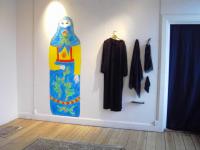
My work is the one on the right handside. The village wall.
art in a time of migration
My work is the one on the right handside. The village wall.
This is exactly how it is. Being Turkish means that one is obliged to become a news-addict that has lots of memory storage in order to be able to explain one massacre with an earlier one, as the left-wing people are always victimized in many different massacres throughout Turkish history. Continue reading

For years I have wanted to burn my EU passport. Because my European privilege was bothering me. It usually happens when Im in Turkey.
Continue reading
Dissertation for MA in Cultural Studies
Goldsmiths, University of London
Student Number: 33182845
London, 2011
Dissertation title
Gendered Ayıp-Shame in Turkish Society and the Overcoming of it Among Turkish Female Avant-Garde Artists
CONTENTS
INTRODUCTION……………………………………………………………………………………………………………… 3
Methodology………………………………………………………………………………………………………………….. 7
Chapter Outline………………………………………………………………………………………………………………. 8
CHAPTER 1 – Socialisation by Shame: Ayıp, Namus, and Mahalle Baskısı………………………………. 10
Cultures of Shame and Guilt……………………………………………………………………………………………. 11
Ayıp-Shame and Socialisation………………………………………………………………………………………….. 14
Namus and Feminine Sexuality………………………………………………………………………………………… 16
Mahalle Baskısı, the Male Gaze and Scopophilia………………………………………………………………. 18
Art as Sublimation…………………………………………………………………………………………………………. 20
CHAPTER 2 – The Turkish Socio-Political Context: Free-Speech, Women’s Rights and Contemporary Art 23
Ambivalently Modern……………………………………………………………………………………………………. 24
Turkish Women and Feminism………………………………………………………………………………………… 27
Art, Censorship and the Lynch Culture…………………………………………………………………………….. 30
CHAPTER 3 – Turkish Female Avant-Garde Artists and their Ayıp-Art…………………………………… 34
Canan Şenol…………………………………………………………………………………………………………………… 35
Nezaket Ekici………………………………………………………………………………………………………………… 41
Şükran Moral………………………………………………………………………………………………………………… 45
Nilbar Güreş………………………………………………………………………………………………………………….. 52
CONCLUSION: Overcoming Ayıp-Shame with Ayıp-Art………………………………………………………… 57
INDEX 1: Interviews…………………………………………………………………………………………………………. 62
Video Interviews……………………………………………………………………………………………………………. 63
Unrecorded Interviews……………………………………………………………………………………………………. 63
BIBLIOGRAPHY…………………………………………………………………………………………………………….. 64
Works Cited………………………………………………………………………………………………………………….. 65
List of Images………………………………………………………………………………………………………………… 70
One day when I was in the 8th grade I went to visit a Danish friend at her house. Although her father was also at home, she opened the door for me only wearing her knickers. I remember my amazement and shock as a Turkish girl from a traditional Turkish immigrant family, raised among the cultural conflicts deriving from this background. I suddenly realized that I felt this situation to be shameful, to be ayıp.
The Turkish word ayıp is a noun meaning shame, dishonour, disgrace or immoral, inappropriate or impolite conduct. It is also used as an adjective, and as an admonishment, as in ‘çok ayıp!’ (‘shame on you!’) While ayıp can refer to many different types of shameful feeling and action in Turkey (as I will explain in depth later), my interest lies in depicting the concept in regards to the conformist female gender role and the repression of their sexuality and desires. Therefore it is chiefly the ayıp concept as well as the ‘ar (sexual shame)[1] concept attributed to women in order to protect namus ([male/family] honour)[2] via mahalle baskısı (social/neighbourhood pressure). To make a distinction from ayıp as a general etiquette or set of shameful actions you should avoid, I have chosen to use the phrase ‘ayıp-shame’ when referring to the specific category of gendered Turkish cultural shame.
The feeling of ayıp-shame, then, was one that I learned to feel in the safe environment of my parents’ living room, where male guests and I, and even my father and I, ended up in awkward, embarrassing and shameful situations, triggered by the assigned sexual roles inherent inside Turkish traditionalism and its associated socialization. This ‘sexualization’ of me in a very young age – not in meaning of as in considering me as an object or agent of sexuality, but as in attributing a sexual identity to me as a female, rather than as simply a family member – separated me from my dad and from the opposite sex and created that unmanageable silence which appeared whenever I was alone with a man. In a way, this sexualization was simultaneously a de-sexualization process, happening on both my and the men’s sides; my being female was supposed to be something that should be treated specially, without any thought of sexuality. Thus, the deep ambivalence of Turkish gender relations that originally derived from the problematic implementations of modernity from the late Ottoman period and through Atatürk’s social reforms repeated itself in our very living room.
My family immigrated directly from a rural area of Turkey and into a meeting with Western modernity that was confusing and contradictory, and is equally so for me, all these years later. Thus while, for me, sexuality, the opposite sex and all individual desires were always to be avoided throughout my life, my Danish girl-friends and their ability to walk around half naked in their fathers’ presence was not ayıp, as in Danish culture there were no equivalent ayıps. The segregation of sexes in my culture, as well as the silence and awkwardness that both ‘sexualized’ and ‘de-sexualized’ me unintentionally, are also part of my experience of the Istanbul metro, where both men and women have to decide in seconds the most appropriate seat gender-wise to avoid embarrassing situations created by ayıp. However, this avoidance of shame always exposes itself as a climate of shame and embarrassment.
It was this omnipresent feeling of shame that I wanted to react against by dreaming of serving tea naked at home whenever I got fed up with the ingrained sex roles of my almancı[3] household. Back then I did not know that these rebellious thoughts and feelings were a psychological reaction to the conformism in traditional Turkish culture, and were to become a part of my desire to become an artist. It is in this cultural setting that I and the women artists who I am studying here partially grew up in, socialized to fit into a modern (yet not emancipated), traditional, patriarchal, pseudo-secular and authoritarian society.
Given this personal longing, my original aim in this research and fieldwork was thus to discover if and how art with connotations of sexuality and desire – what I am calling here ‘ayıp-art’- could exist in Turkey. Ayıp-art – shameful art – is art that is equated with sexuality or other taboos initiating ayıp-shame or sexual shame in the viewer. Although I have never seen art being described explicitly as ayıp on paper, I have observed the ayıp that was built into several art works and the representation of these art works in the media. One is able to trace the moral values of the majority of Turks in their encounters with and reactions to these art works, and as I too had passed most of my childhood labelling some films (but not others) as ayıp, it was natural for me to name this category of art as ayıp-art. I also found myself testing the Turkish female art against my own shame-levels to prove that it was really what I wanted to call ayıp-art, and this situated me among the traditional majority of Turkey and their view of morals in regards to women in general.
Yet Turkey has of course changed in the almost 40 years that my family have lived in Denmark. In fact, as we shall see, Turkish art is flourishing with themes taking up sexual taboos and the questioning of women’s position in society among other issues. Turkish female avant-garde artists seem able to overcome ayıp-shame in order to do their art, despite the internalized power of ayıp norms, depicting the sexual taboos of Turkey through the use of bodily performances, nudity or sexual and sensual connotations that are considered shameful by the majority of Turkish people. I find the art of Turkish female avant-garde artists works to be brave, unique and important for women and the women’s movement in Turkey.
Yet, for me, these artists’ bold and challenging work also raises several important theoretical and political questions, which this thesis sets out to answer. Firstly, although these artists can deconstruct such cultural norms such as ayıp, are they themselves – and their work – fully free from shame? Can one fully emancipate oneself from the power-structure written inside the system, which has historically held women in an inferior position? How do female artists, in enabling themselves to make art that is judged to be ayıp, learn to deal with ayıp and the shame deriving from these limiting rules, despite their families, the Turkish society and its psychological pressure and consequences?
In terms of the methodology I used to answer these questions, it has sometimes been hard to unveil this concept of ayıp, as everyone seems to know what it means but only few know how to articulate it. Also, on the theoretical level, a sociological analysis and a conscious language and questioning are missing in regards to the terminology of ayıp. Hence it is often hard to discuss the ayıp concept beyond a description of a traditional upbringing in Turkey and the idea of ‘eb[4] in general in the Middle East[5]. I have therefore had to draw on a wide range of sources from cultural theory, particularly Freudian and Lacanian psychoanalysis and their feminist (re)interpretations, while still taking my own life experience of being brought up and socialized with ayıp as a Turkish girl as a starting point.
Finally, a one and a half month period of fieldwork in Istanbul was crucial to my further research and understanding. I chose to live in Cihangır, Istanbul, to get the best insight into what it meant to be a woman, and a female artist in Turkey, and in order to understand how these women artists are able to do art that is considered ayıp (shameful) by the traditional majority. The fieldwork was mainly carried out via filmed interviews with four Turkish female avant-garde artists – Canan Şenol, Nezaket Ekici, Şükran Moral and Nilbar Güreş.[6] I chose to do direct interviews because I wanted to avoid orientalising my subjects. In the West, Turkish women, who are also considered as Middle Eastern, are often represented as suppressed by their husbands, families and Islam and thus as needing to be saved. I wanted to allow Turkish women to speak for themselves, rather than simply comparing them to Westerners, as they are not only victims of their society but actually have a lot to offer. I wanted to understand the background of my four interviewees from a specifically Turkish perspective, and understand its contribution to the production of Turkish avant-garde art and international art scene. In addition to these four in depth interviews, I conducted interviews and discussions with other Turkish artists,[7] with curators,[8] feminist cultural activists,[9] gallery owners[10], art-critics[11], students from the colleges of art and cinema,[12] and academics in the Cultural Studies Department at Bilgi University[13] and at the Women’s Studies department at Istanbul University[14] In order to better understand the specific Turkish socio-cultural context.
In the first chapter of this thesis, then, I analyse the Turkish traditional concepts of ayıp, namus and mahalle baskası in the light of recent psychoanalytic and cultural theory. In the second chapter, I analyse how the Turkish socio-cultural and political context structures, understands, affects and responds to women and art in general, and feminist women’s art in particular. In my third chapter is a discussion of the works of the four Turkish women artists which I argue can be read as ayıp-art, as well as an analysis of their own readings of their work presented in the interviews.
It is hard to ‘unveil’ the topic of ayıp in Turkey because it is a concept that everyone seems to know the meaning of but only few know how to articulate. Many people are unaware of its effects on their lives and psychologies, especially on those of women. The following is an attempt to bring this half-submerged concept into the light of conscious analysis, using the tools of psychoanalysis and feminist cultural theory.
For Freud, shame and guilt are connected emotions. It is during the Oedipal phase that a child’s future sexual roles and identity are structured, resulting in a super-ego that internalizes the rules of the father, and this guilt, along with other guilty feelings, is linked to desire in general, and is accompanied by the emotion of shame. Thus shameful actions become equally sexualized during the pre-Oedipal period[15] and the Oedipus complex and its unconscious sexual guilt.[16] This Oedipus complex recurs every time our own desires conflict with what is morally acceptable in our families and in society all through our adult lives. Still, the female Oedipus complex is much more complicated as there is no castration sanction towards girls. For Freud, as girls have already been symbolically castrated, this implies that girls develop their own Oedipus complex whereby they gradually accept the father as their sexual object and learn to control their sexual desires.[17] Lacan, however, reads Freud’s Oedipus complex and the subsequent castration anxiety as a way for the infant to understand and accept that all desires cannot be satisfied and therefore that it has to overcome disappointments to become an independent individual.[18]
For Gabrielle Taylor, speaking more generally, shame is an emotion one feels when in a position threatening one’s integrity.[19] Thus Taylor defines ‘the emotion of self-protection’[20] as ‘genuine shame’.[21] Genuine shame has a positive and necessary side defending the individual from actions damaging its identity and values, since shame is about how one sees oneself and also how one understands oneself to be regarded by others. Therefore shame is a useful and ‘genuine’ emotion when not deriving from a set of cultural moral values that is imposed on the self.[22] On the other hand, shame which conflicts with one’s true beliefs, emotions and integrity is named ‘false shame.’[23] We could therefore understand ayıp as a ‘false shame’ maintained through a culturally constructed shaming.
Similarly, Piers and Singer identify ‘cultures’ of shame and guilt, in which shame appears in both as an internally and externally rooted emotion.[24] Yet the ‘internal’ and ‘external’ facets of shame cannot be so easily distinguished since either they are either mixed most of the time, as Piers and Singer believe,[25] or they cannot, as internal values, be easily distinguished from the cultural values wherein they are mostly rooted. It is hard to believe that shame is always internalized in ‘shame cultures’ in opposition to ‘guilt cultures[26] where individuals have only the feeling of ‘genuine shame’.[27] However, whereas most Western cultures are classified as ‘guilt cultures’ that rely on an internalized conscience and sanctions, non-Western societies such as Turkey are often labelled as ‘shame cultures’, where moral authority is perceived to be in other people and their ability to safeguard honour.[28] However, according to Singer, guilt is also part of ‘shame cultures’[29] since both guilt and shame are connected emotionally.[30] He states that ‘shame cultures’ do not lack internal sanctions of guilt and moral conscience, and in this way they are similar to Manion’s concept of ‘false shame’.[31]
Turkey can be understood as a ‘shame culture’ where guilt largely exists through religious repression via a punishing God in the hereafter.[32] The origins of ayıp in Turkey do seem to be affiliated to some extent with günah (religious sin), since moral codes partially derive from religion and religious fear becomes yet another tool for the repression of sexuality. Still, as İsmet Berkan says, it cannot be assumed that the origin of moral codes and thus implicit ayıp codes come only from religions.[33] For example, being sinful is regarded as a human thing in Islam and one does not need to feel guilt, as long as one repents. Nevertheless, it seems that women as well as children must accept more divine authority and have more takva (fear of God) than men.[34] Turkish society is thus built up around this shaming culture where the gendered terms ayıp, mahalle baskısı and namus are shaming and regulating functions that maintain public moral values.
The Turkish word ayıp, that is generally used to distinguish right from wrong, is generally translated as ‘shame’ in English. However, utanç, the Turkish word for the emotion of shame, is also translated as ‘shame’. This indicates that the word ayıp has an inbuilt emotion – shame (utanç) – that can be activated when doing something immoral. Others can also shame you (ayıplamak). Thus ‘[ayıp]/’eb is the catch-all concept for all kinds of shame’[35] that contradict the society’s moral values, and thus unify people via shame.[36] ‘Ayıp-shame’ can thus both mean the actions that one is expected to do and at other times the behaviour that should be evaded. As shame is generally linked to bodily desires and needs (libidinal drives, in Freud terminology), those exposed to or not able to control these needs are shamed. Ayıp-shame is therefore the result of what Mary Douglas calls ‘intimacy in the wrong place.’[37]
Therefore taking the last piece of cake on the table, having sex, being homosexual or even talking about sex, female adultery or loss of virginity before marriage,[38] explicitly saying that you will urinate (especially in the presence of men or people older than yourself), being naked or wearing knickers or even lying on the couch when your father is present, or refusing to serve tea for guests all become objects of shaming and thus ayıp. Hence all that is related to one’s body (and especially all that is reminiscent of the female body) as well as to individual desires is to be considered ayıp; and this is especially so in a culture that is mainly based on a collective family structure and not on individuality.[39] According to Freud, sexuality is the most important point in psychoanalysis since civilization is at least partly founded upon controlling and repressing sexuality.[40] Thus sexuality has gradually been transformed into something shameful in many cultures. Mollon proposes that this is due to sexuality’s power to threaten the socio-cultural world and therefore it even has to be repressed in the West’s ‘supposedly sexually liberated society’.[41] Moreover, Freudian scham[42] is directly related to sexuality or specifically to exhibiting the naked body and the genitals,[43] what Turkish culture refers to as the ayıp yerler (literally ‘shame/ful places’). Thus it is libidinal repression, namely a sexuality exposed via shame,[44] that is a symptom of the biggest taboo in Turkey.
Yet sexual shame is constructed differently depending on gender. According to Freud[45] and Manion[46] and Block[47], shame is asserted as a mainly feminine emotion. Women have a tendency to arrange their sense of self around feelings of shame, and to want to fulfil their expected ego-ideal to avoid shaming.[48] According to Kağıtcıbaşı, this is associated with women’s inclination to be more dependent on their family from a very early age in their socialization.[49] Yet shame and guilt are concurrently crucial in the development of the ego, as the character is taking form.[50] Therefore, shame is equally important in the development of a gendered individual, as social customs force women into a ‘passive’ and secondary position in the family and in society.[51] The Freudian superego and ego are affected by parental socialization. The parents control women‘s actions via the child’s fear of withdrawal of love or punishment and a sense of guilt if they reject the parents’ moral values.[52] If women are thus more socially prone to shame, as Freud and Manion argue,[53] then this perhaps explains how ayıp can self-discipline people or rather women in order to conform and avoid sexuality. This thus keeps the majority of young girls and women from doing ayıp things, though their genuine desires may cause them to feel shame and guilt toward themselves as well as toward their family and society. Shame thus becomes a feminine attribute in the cultural memory, while men are not expected to feel shame.
To comprehend ayıp’s function in the family and society it is finally important to understand the concept of namus (honour). Ayıp and the behaviour patterns it dictates function to prevent the insults to reputation and thus protect the honour of men or families.[54] By not following the ayıp-norms of the society, one risks losing honour and status in the eyes of others.[55] Honour needs to be defended or re-established if damaged since, to maintain the honour one accrues through the community, one has to protect or reflect others’ honour as well. Turkey can thus still be seen as an honour-driven country where everyone only lives for their namus.[56]
On the whole, the Turkish ayıp system makes a man’s honour rely on the sexual actions of his women.[57] While ayıp behaviour only brings shame to the individual’s acts, violations of ‘ar (sexual shame/sexual honour) bring shame upon the whole family[58] and are thus connected to namus.[59] Therefore, ayıp-shame and honour are closely interconnected in Turkey,[60] as namus constantly disciplines women’s relation to their bodies and sexuality via ayıp[61] as, in Turkish culture, honour is ascribed to men only, and shame is left for the woman to feel.[62] When women want to resist or change and leave this imprisonment,[63] this sometimes leads to honour killings or compelled suicides when women force the moral limits in the name of emancipation.[64] Still feminists as well as artists and Unni Wikan do not agree with this male dominated and male created concept of honour whereby women are the object of shame only as a part of men’s honour.[65]
This namus concept that traditional Turkish culture is based on is produced and controlled by ayıp/ayıplamak (shame/shaming) via mahalle baskısı (social pressure) and not purely by guilt as in Christian culture.[66] Yet since, in all cultures, conformity must be achieved via either shame or guilt to guarantee social integration,[67] Turkish society subjects the moral codes of the private realm to politicization and surveillance.
Surveillance leads us to mahalle baskısı (‘neighbourhood pressure’); a frequently used term in the Turkish media and in the lived experiences of secular modern Turks. In contemporary times, mahalle baskısı forces conformity within a neighbourhood using ayıp (shaming) as a tool. It is intended as an invisible pressure to make people follow the rules of ayıp (shaming norms) in the mahalle (neighbourhood). This another control mechanism and, I would argue, mainly of women. The mahalle can also be read as a microcosm of the whole country, which thus needs to protect its purity and its namus (honour).[68] While this term must have had a deeper function in earlier times whereby everyone was looking after each other in the sense of taking care of each other, in modernity mahalle baskısı means everyone’s surveillance of and interference with each other. Mahalle baskısı aspires to normalize everyone, and ayıp and namus are never scrutinized or questioned as the male hegemony depends on this obscuration of the ‘traumatic real’ in Lacan.[69]
Thus the male gaze that has been internalized within the woman is also a part of the mahalle baskısı which functions as a controlling tool of women’s bodies and sexuality. This at once approximates to the ‘scopophilia’ in Freud’s psychoanalysis, as the pleasure of looking at objects which gives sexual pleasure. Psychoanalytic film theory has also examined the special dynamics of Lacan’s ‘imaginary gaze’ that has a symbolic base which hides the power of the symbolic order as well as the ‘real’, and Laura Mulvey associates this gaze with ‘male spectatorship’ in general.[70] This explains the female role of passive object to be looked at by the active male gaze. In a patriarchal society, such a gaze has proliferated in Turkish men, who see it as the duty of women to protect themselves from this gaze for the sake of their husbands’ honour and their own ‘ar, as men due to their nature cannot manage to restrain themselves.[71] As Gertrud Sandqvist rightfully points out, even in the ancient times, ‘it was […] the woman who had to bear the shame if she was caught by male eyes while changing.’[72] .Therefore to actively stare at women is permissible, thus giving rise to the passivity of the female object that is gazed at in films too.[73] Turkish men daily justify their pleasurable gaze as a necessary indictment of women with the shame of being under-dressed.[74] This logic can even lead to mitigating circumstances in juridical cases where men have assaulted women.[75]
By the same token, Turkish men might feel freer to commit ayıp or dishonourable actions in new settings where they are unknown, disregarding any mahalle baskısı in a neighbourhood not their own, or in situations where a woman is unknown to them. The negotiation of shame depends on mutual recognition and thus, seems only to have a meaning in a specific social context, leaving women who are living away from their family and neighbourhood vulnerable, appearing as easy bait for men. Many women and young people move to Istanbul from smaller cities of Turkey in order to set themselves relatively free from the controlling as well as protecting mahalle baskısı of their home towns. This cosmopolitanism brings about a society that consists of smaller groups who are sexually emancipated, but who are still under the gaze of a traditionally bound masculine majority, which represses women with a sexualizing gaze.[76] The male gaze, and the perverted verbal abuse that so often accompanies it, keep women in their inferior positions via the ‘symbolic’ of Lacan.[77] Intimidation makes it difficult for women to break free of their repression[78] and shames them when they don’t behave virtuously.[79] Hence the male gaze in public spaces as well as in the representation of women in the media reproduces the namus (honour) concept via the self-consciousness activated by shame[80] due to the repression of sexuality in Turkey. Yet this disciplining gaze, of which men are not fully conscious, has something of the ‘real’[81] about it. Women sometimes sense this, especially in films and arts, giving the subject an opportunity to obtain recognition and freedom.[82]
All in all, in Turkey shame seems to be the emotion that is thus used to keep women’s sexuality under control lest it ruin their family’s namus. Consequently, this moral value rigidly dictates behaviour in Turkey, affecting women psychologically.[83] Through its implementation in the early female socialization, women tend to react more strongly in shameful situations.[84] In the worst cases this can lead to psychological problems, behavioural problems, and psychosomatic conditions.
Turkish women thus long for a freedom that does not exist in real life in Turkey, and art is a way that allows these dreams to exist.[85] The ‘ar (sexual shame) and ayıp-shame which Turkish society is always trying to cover up for with these ayip codes is activated through contemporary art by the four Turkish female artists that I am scrutinizing. For Lacan there is exactly ‘a connection between artistic production and dream-states.’[86] Via sublimation the artist can collectively convert intolerable libidos and thus the Turkish ayıp behaviour as well as censorship issues into socially accepted manifestations in art. This is because art comes out of repression and contains a desire for reparation and recovery for the artist[87] which is the basis of sublimation. Art contains ‘manifestations of unconscious drives’[88] which includes the struggles between the ego and the id, since it is in the Lacanian and Freudian mirror stage that the Ego is founded and thus the ‘I’ formed in regards to cultural norms in an ideal-I.[89] Furthermore, it is in the mirror stage that we first experience the Lacanian ‘wholeness’ in an imagined version of ourselves. Women artists and their viewers thus experience a feeling of ‘wholeness’ which is usually reflected via others, in films, video art or even in performance-art.[90]
So despite the societal setting based on the ayıp norms, namus and mahalle baskısı, there are many young women who can de-construct these institutionalized moral values as well as the constructed gender difference as being untrue.[91] Hence art or academia is a place where a woman can learn to deal with or overcome the moral codes and their imposed shaming internalized via socialization. Art in particular is a space where one can bend the rules where necessary in order to follow one’s own path, to become oneself; or even an artist, and to do the art that is regarded as ayıp because it challenges these repressive issues and taboos. Yet, as free as it may feel, art cannot escape its social context, and it is this that we will examine in the next section.
To understand the difficult position of Turkish women generally, and female artists in particular, in Turkey being constantly torn between a traditionalism consisting of feudal, Islamic and patriarchal values and a Westernized modernity, it is first necessary to understand the Turkish version of modernity and its dilemmas in the socio-political setting. Although Turkey seems a modern country from the outside, Turkish society is mainly described as being traditional despite urban transformations, consisting mostly of the socio-economic sub-group of ‘rural-urban migrants’.[92] This is similar in many ways to the situation of Turkish immigrants in Western Europe. Therefore, focusing on the traditionalism of this majority can give us a better understanding of socialization and repression through ayıp. It can also show us where the art expressing such ayıp derives from, since the biggest problems for women and female artists lie within these traditional values which are less common or non-existent in the upper classes and intellectual groups.
Turkish modernity has its roots in the late Ottoman period,[93] yet the early twentieth-century reforms remained superficial and not sufficient to lead any major cultural change in terms of gender equity.[94] Atatürk’s early republic was autocratic rather than something gained after a democratic or rebellious act,[95] and could therefore only transform the superstructure of the country, but not the belief system and values of the people. While the country was forcibly secularized in the mid 1920s and the Islamists were oppressed by Atatürk and did not have any say in the new Kemalist order,[96] the anti-secularist Muslims had a political comeback by 1948. This was because the social reforms of Atatürk had intervened into social domains but ‘could not achieve hegemonic status,’[97] the Turkish political landscape witnessed a struggle between Atatürk’s ideology of modernity gathered around secularism and statism, and an Islamic conservatism accompanied by right-wing liberalism. The coups d’état in 1960 and 1970 were both moves against this latter ideology by the ‘Kemalist’ military[98] Militaristic authority in the name of Atatürk is the main reason why every political party in Turkey since Atatürk’s death has had to associate themselves with his legacy.[99] Ironically in the 1980 coup d’état, the Turkish military again justified its interference by referring to Atatürk and his founding principles, although this time addressing the threat not from Islamism but from the left and communism.[100]
From the middle of the 1990s, this political inheritance has made Turkish Islamists and secularists alike undergo changes from the middle of the 1990s that have divided the republic into two polarities. And both groups have longed for a time where their political belief was sovereign in Turkey.[101] Nostalgic Kemalists’ long for a time where Turkey was more modern and not veiled, whereas the Islamists’ long for more religious freedom and structure. The latter group’s longing has gradually been realized by the AKP (Adalet ve Kalkınma Partisi: ‘Justice and Deveopment Party’), the Islamist party that has been in power since 2002.
Through AKP politics linked with Islam, the general administrators in many institutions have become AKP supporters, and have sought to impose their moral and religious values by using their authority at all levels of the bureaucracy. Although the AKP plays safe by denying Islamist aims, it is evident that religion is ‘organizing in social life, [and] there is an intertwining of religion and politics.[102] Although Prime Minister Erdoğan has made a great effort to be accepted into the EU by apparently meeting requirements for human rights, pretending to be the solution-maker for the oppressed Kurdish communities as well as implementing legal changes for the benefit of women, these legal changes and promises have not been upheld in practice.[103]
Hence indications of the AKP being democratic and reformist are rather misleading due to their use of ‘popular politics’[104] to gain office. Thus the state often claims to leave the decisions on moral and religious issues to the people to pretend to be democratic. This is evidenced in the article 301 of the Turkish penal code which still prohibits the ‘denigration of Turkishness’.[105] Yet even what is considered to be protected and permitted by law can actually be prohibited in practice. According to Şerif Mardin, one can even risk a prison sentence even for scrutinizing and disclosing the socio-political structures in Turkey.[106] Thus a set of written and non-written censorship laws exist, as, despite the liberal discourse of the government, the religious, patriarchal and conventional values of its leaders may easily manipulate and dominate the justice system.[107] This hypocrisy unveils itself in self-expression practices where censorship is transformed into self-censorship in issues of morality, politics, and religion.[108] This evidences a Turkish political arena that has gradually transformed into a place where one thing is uttered and another is done and the real agenda is generally hidden, and is characteristic of the canting that has become especially evident in public discussions since the AKP’s coming to power.
In a series of discussions in media,[109] sociologist Şerif Mardin points out that while Kemalists blame the AKP and thus the Islamists for the creation and upholding of the term mahalle baskısı, Turkey is a state that uses the disciplinary gaze unconsciously rather than thinking and talking in line with its conscious, constitutional laws. He consequently does not believe that AKP alone is responsible for this terminology or its reproduction by the majority of the Turkish population,[110] since mahalle baskısı existed even in the Ottoman era.[111] This shows us that any side in Turkish politics can use any debate for their own advantage as social sciences is not encouraged to scrutinize these deep-rooted Turkish concepts to question and criticize a patriarchal society instead.
Although women were given some major civil rights via these early republican reforms, such as the right to divorce and to vote, research from 1950s and 1960s shows that women were still largely subservient to men,[112] and the change made itself felt only for a small percentage of the population of Turkish women.
Furthermore, as Dilek İmançer points out, the republican dress reforms did not in fact equalize the sexes, as Atatürk’s role for women was in fact only a traditional one, although egalitarian in juridical terms.[113] This contradiction within Turkish modernity continues even today leading to identity management problems for women as well as men who have had to find new ways to function in the public spaces and still keep their respectability intact. As Deniz Kandiyoti has argued, without the veil women were not protected any longer since Turkish society was not ready to meet women who were normally segregated from the public realm. Hence chastity came instead of the veil, but chastity was never a stable solution. And no matter how ‘disciplined and de-eroticized’ it became, the female body turned into in order to survive a male-dominated social realm. In this realm, the many images offered by global consumerism continued to affect the Turkish man, and his ‘ambivalent male gaze […] continued to sexualize the female body and presence.’ Therefore, Kandiyoti concludes, the new female veiling of the 1980s and 1990s ‘may be bringing this inherent contradiction to its logical conclusion’[114]. This means that veiling would probably be better for both women and the traditional mentality of Turkish men. The AKP would of course consent to this, but the secularists and feminists could never agree to it;[115] and especially since they claim to feel mahalle baskısı even more since the AKP gained office.[116] Thus the contradiction continues.
Another argument for the exaggerated sexualizing of shame and ayıp in Turkey is the historical absence of a sexual revolution.[117] Both from a societal and religious point of view sex is ayıp, forbidden and sinful, and is still largely only allowed within the institution of marriage[118]. The issue of sexuality remains a cultural paradox and neither the media nor the state takes adequate responsibility for sexual education or sexual health, though this is advocated by the Cinsel Saglik Enstitüsü Derneği.[119] In addition, besides the efforts of the organization Habitat[120] and different NGOs[121], the deficiency of sexual education in schools or within the family is perhaps unsurprising. Sadly, even talking about sex is ayıp in a society where everyone pretends that sex doesn’t exist. On the other hand, there is great interest in commodifying sex and women’s bodies, with the Turkish and international media exposing sex to its limits, and exploiting the commercial possibilities of the male gaze. Yet since shame commonly revolves around gaze[122] and the judgement deriving from the gaze, this is being transformed into a part of a male gaze due to sexual repression as stated earlier shame becomes exactly a reaction towards scopophilia.[123] The cumulative effect is to leave women to their own destiny in regards to sexual harassment and daily reports on violence.[124]
Furthermore, the AKP’s intertwining of politics and religion tends to legitimize a lower status for women in Turkey, as well as an even greater segregation and sexualisation of women, as the gender equality they advocate is based on the proliferation of the already patriarchal values. Despite the AKP gradually bringing freedom of choice to veiled women, there is, according to Yeşim Arat ‘a democratic paradox where the expansion of religious freedoms accompanies threats to gender equality.’[125] It is therefore not the ban of the headscarf being lifted at universities that is a danger to democracy and gender, but ‘the propagation of patriarchal religious values that sanction secondary roles for women, both through public bureaucracy, the educational system and civil society organizations.’[126] Thus once again bringing a picture about of a country pretending to be modern but which is mostly traditional.
Women need to struggle hard in Turkey to obtain their rights in real life and not just within the laws that are expedited by men.[127] However, unfortunately, as Şirin Tekeli states, it remains a common belief among traditional women that changes to any marginal situation ought to be implemented top-down by the state.[128] Women need to refuse this male dominated system and instead bring their own new alternative identities; in Turkey, this means building identities outside the given conflict arena between Islamism and modernity.[129] And Turkish female artists seem to be doing this already via their activities in the arts, and in feminist organizations such as Filmmor.[130] Yet however determined the Turkish feminism and feminist art that has had its comeback since the 1980s,[131] it still needs to progress further.[132]
As shame is a ‘moral emotion’[133], then this leads us to understand how moral values are directly and indirectly politicized via laws in Turkey. Due to decades of consensus among the Turkish majority, moral codes are often connected and incorporated into the law, particularly the Turk Ceza Kanunu. Police can arrest citizens if disturbing the majority’s moral values by ‘behaving shamelessly’, i.e. making a public performance invoking ayıp to cause shame among passers-by and viewers. Interestingly, while this law is based on the society’s supposedly common moral values, it is actually heavily politicized. It is therefore obscene that the RTUK,[134] part of the Turkish state, should appeal to collective values in censuring things on TV that are not among the expected gender roles, mainly of women. TV series regularly get censored or fined by RTUK for threatening the ‘moral’ values of the society, yet many other ethically wrong things – violence for example – do not get penalized equally.[135] Thus the state censures creative freedom in the media and arts, especially when they challenge ayıp norms.
Yet other times the state leaves the decisions on moral and religious issues to the public in an act to pretend to be democratic. Obviously, within the Turkish art press all art – including ayıp-art – is of course considered normal. But it is in the tabloid press that contemporary art (if it ever gets there) is almost universally vilified.[136] Thus the only art being discussed involving the wider public are the sculptures depicting love, sensuality, sex or women’s bodies which are ‘freakish, immoral and useless’ according to prime Prime Minister Tayyip Erdoğan.[137] Thus the unrelentingly negative and reactionary discussion of sculptures is the most common or only mode of art appreciation in traditional people’s lives. Indeed, it seems the only way to bring art and politics together, as it is the only place where this happens for the wider public. As Beral Madra puts it; ‘contemporary art practices, in general, are not included into the culture politics of the political and economic actors.’[138] Yet this also politicizes the private sphere and sexuality by actively removing objects that can be understood as in any way sexual and hence ayıp. By emphasizing the ‘immorality’ of obvious sexual connotations within the female avant-garde art, by publishing them in the tabloid press, by (in a sense) shaming them, and by denigrating contemporary art and women/artists who attempt to question and change the male-dominated society, by repeatedly enforcing the limits of the public moral values, the AKP indirectly and secretly carries out its gender politics agenda.[139]
Yet such populist stances have social consequences. The Tophane gallery attacks, for instance, were generated by the Islamic sensitivities of radical sections of the community who justified their actions with the reality that the alcohol and half-naked women on display in the galleries were disturbing their mahalle’s namus.[140] This is further evidenced in the violent attacks on art students at Marmara University who were forced to give up nude sculptures and paintings that are considered immoral and ayıp according to the ülkücüler (the ultra-nationalist youth wing of the MHP [Milliyetçi Hareket Partisi – National Movement Party]).[141] Finally, and perhaps most importantly, because of economical background, lack of education, time or knowledge about art, only a small percentage of the Turkish population has access to art. Fewer still are aware of it as a possibility for enabling social change, such as by bringing human and gender rights onto the political agenda in Turkey. According to Levent Calıkoğlu, art is still seen as something ‘not so important’ that only well-off people and academics have access to.[142] This loop never changes, and the art works by politically engaged Turkish female artists do not get recognized in the media as ‘political protest or activism’[143] and people are not schooled to analyse the abstractions of art as metaphors for their daily troubles.
It is then in this social and political setting that the female artists and I partially grew up, socialized to fit into a modern yet not emancipated traditional, patriarchal, pseudo-secular and authoritarian society. Although Turkey has developed within the last 40 years since my own parents emigrated, sex and sexuality have still not become normalized.[144] Therefore, to think that Turkey has become an easier place to live for women is mistaken according to my experiences, observations, and my readings.[145] It is a mistake to think that Turkey has become an easier place to live for women. Taking the political arena into account and its censorships, and as well as the lack of education it is apparent that Turkey is indeed a challenging place to live as a woman and also to be an artist. Yet all over the world, feminist art or female artists’ art addresses their political and gender issues consciously, unconsciously or on purpose, and this is also the case in contemporary Turkish female avant-garde art. Since ayıp themes among other taboos[146] are an ongoing and flourishing theme taken up by many female as well as male artists.[147] As Madra argues, back in the 1980s these taboo-breaking artists ‘were not identified by the general society as part of a woman’s liberation movement or as a search for a new identity for women.’[148] Yet, today, we should certainly evaluate these works as ‘pioneering representations of a postmodern feminist identity emerging amongst women.’[149] Today in 2011, such art can surely make a difference towards a democratization process for feminists and women in general.
CHAPTER 3 – Turkish Female Avant-Garde Artists and their Ayıp-Art
This last section will discuss examples of ayıp-art that is shame-triggering and taboo-breaking by four leading Turkish female avant-garde artists. The art works presented and analysed in this upcoming chapter all thematise the societal taboos, the consequences of the female ayıp-socialization and the repression of their sexuality that has been described theoretically in the first part. As we saw in the second part, such art is regarded as ayıp in the terminology of most Turks and is dealt with ambivalently by state and media institutions. Therefore, the aim of the discussion is to understand how or to what extent these artists are able to break free of the shaming society depicted earlier.
I met with artist Canan Şenol in her beautiful light flat in Avcilar Istanbul in the beginning of October 2010. Şenol is a self-proclaimed feminist, yet she wanted the curtains drawn while we were filming the interview with her, so as not to exhibit herself too much, due to threats caused by her provocative art. Thus Şenol works with the ever present fear of the crowd’s moral values, and of a police state.
Şenol’s work İIbretnuma (Exemplary)[150] is an animation telling the story of the beautiful Fadike and her life in a society with institutionalized pressure in both marriage and within the family and its psychological results. The work objectifies a body ruled by the state, religion, society, and the family; in short, the political power mechanisms used to gain power over women. The piece examines how, through socialization at all levels of society, women learn how to act as expected, by developing an ego-ideal according to the ayıp rules, fearing and avoiding shame and upholding family honour.
Image 1: Still from İbretnuma by Canan Şenol
The artwork shows how the patriarchal side of Turkey controls women through veiling and other issues in order to either normalize or exclude them. This suggests Irigaray’s reading of Lacan[151] that proves the woman’s position as to be suppressed within the male system in order for men to retain power over women, and to hide the power of the symbolic within the ‘law’[152]. Şenol is convinced that İbretnuma’s sincerity and familiarity in its way of deploying the ‘inexpressible’ in women’s lives, namely the ‘imaginary’ of Lacan, is one reason why it was so popular amongst women. Also, the work provides a peek into the female jouissance described by Lacan[153] that women have forgotten because male hegemony keeps it repressed and veils it inside the imaginary and the symbolic. Therefore the female subject might have ‘symptoms’ of sadness while watching this video as a Freudian formation in the unconscious, but simultaneously also a ‘…pleasure of dis-identification.’[154]
As well as challenging religious and cultural traditionalism, Şenol also does performances to provoke the secularists who are supposedly the modernists of Turkey, such as with the performance Hicap. This is an important work which elaborates on the fact that the female body is constantly used to manipulate the politics of Turkey into the everyday lives of people.[155] Dressed in accordance with Islamic veiling, Şenol entered an exhibition by Kemalist artist Adnan Çoker who had previously asked people to wear hats for the preview in line with Ataturk’s dress reforms. In reply, Şenol together with two artists veiled themselves to enter this secular setting that commonly feels disgusted by veils[156]. This performance questioned the apparent discrimination towards practising Muslims that Çoker’s secularist, patriarchal and elitist request characterized. It thus showed the public that there are also secularist feminists, leftists or artists who are also open-minded towards the right to wear the turban (‘headscarf’) and about the dominance of secularism.
Şenol states that the problems of the foundation of Modernity in Turkey are still evident, and that Turkish women have been exposed to difficulties as modernity was implemented to declare equality with the West using women’s bodies as an object in this rivalry[157]. Modernity has often been analysed in Turkish society through the position of women, as both Turkish men and the West measure their modernity via their women.[158] Yet since the beginning of Turkish modernity, men have insisted that their women both become modern and remain chaste and pure before marriage. The discourse on veiling has orientalised Turkish women both from the inside of Turkey and from the West, covertly sexualizing them, invoking gendered ayıp-shame via the veiling. Yet Şenol’s work is even considered ayıp according to the secularists’ norms of respect for republican traditions. So it seems that the female artists like Şenol answer back with their bodies, using the same weapon as the state to take revenge or to become equal with their enemy. Consequently, veiling, as well as undressing, can be considered ayıp, depending on the space and situation.
Image 2: Photo of Hicap by Canan Şenol performance:
Şenol’s work Çeşme (‘Fountain’)[159] gives us our first example of an artwork that has connotations of female sexuality and is thus ayıp in the eyes of the Turkish majority because it lacks ‘ar (sexual shame). The video displays Şenol’s breasts lactating after she gave birth to her daughter.[160]
The work is in dialogue with the work of the same title by male artists like Marcel Duchamp and Bruce Nauman, and challenges sexist or objectifying Western views by referring to bodily fluids. Thus Şenol creates the first alternative feminist fountain in Turkish art. She breaks the link between women either being the chaste mother or the sexual object of men’s desires by means of a pair of dripping breasts, filmed as disconnected from the rest of a female body, and which thus cannot serve the desires of men. Moreover, she resists the male hegemony that is also the ‘symbolic’ of the majority of Turkish women by publicly showing her breasts – and this despite the societal sexual shame of the mainstream readers and the journalist in the Radikal newspaper who see even indicators of genitals or sexuality as ayıp.[161] Thus Şenol’s work deals with the politicizing of the private sphere in Turkey by normalizing women’s desires.[162]
Image 3: Still from Çeşme by Canan Şenol
Nonetheless when asked about her own view of ayıp and gendered shame, Şenol states that, when doing a performance or other daring work, she deliberately restrains herself from thinking about the consequences of her artistic deeds up until the work is finished. Afterwards, however she is often surprised and even scared by her actions. She started out doing naked performances in the first years of her university degree in fine arts. While she was shy and embarrassed in front of her teachers and fellow students in the beginning, this feeling diminished as she became surer in her artistic language. Furthermore, she states that women working on gender issues are prone to use their body in their art, whether this is to undress (as in Çeşme) or to veil oneself (as in Hicap).
As for Şenol’s relation to her parents, she states that she and her parents have an unspoken agreement that they do not talk about everything regarding her art. This keeps their relationship ‘conflict-free’[163] Shame is thus not fully overcome by the artist or the artwork within the family and society. Although Şenol is emancipated to do her art, to live alone with her daughter and to be herself, she still respects the borders boundaries of her family.
Another internationally acclaimed Turkish performance artist who makes ayıp-art (in my opinion) is Nezaket Ekici, who grew up in Germany[164]. But surprisingly, in my interview with Ekici it became clear that she does not see her art as being ayıp, as her point of departure is never intentionally to do ayıp-art at all.[165]
Yet when Ekici’s work Fountain for 6 Women[166] was performed with see-through costumes in Eastern Turkey, it was treated as ayıp according to the reactions of the audience and particularly the local governor, who left the performance believing that the six performers including Ekici were naked (although no one really was).[167] An even more worrying example of how the work was received as ayıp were the comments (by men) on the online article describing these events, which supported the moral values of the governor and mainstream Turk, while criticizing female artists for objectifying their own gender, and using very sexist and denigrating remarks towards women in general, the women artists, and all modern art.[168] Despite the fact that even connotations of being naked, being nude or wearing see-through clothes are considered normal in feminist art in the West and in the Turkish art scene, it is still very new to provincial Turkey due to their ambivalent form of modernity.[169] Another reason is what Abidin Dino calls the comparative ‘delay’ between Western and Turkish art,[170] though the art being made in Turkey since the 1980s (and especially by the artists described here) has finally brought a consensus contemporaneity to this gap.[171]
Image 4: Photo of Fountain for 6 Women by Nezaket Ekici
Another of Ekici’s works which can be read as having the features of ayıp-art is Emotion in Motion.[172] In this gallery-based performance, Ekici wears a sexy nightgown while continuously kissing an all white room with everyday objects and furniture, including parts of her own body in a sensual way. Ekici herself states that the work ‘Emotion in Motion’ was created to show her gratitude towards these everyday objects; like all of her other works, it contains its own concepts, and carries no intentions or implications of ayıp. She states that the piece neither aims to provoke Turkish people, nor to gain approval of for being a good Westernized woman artist, and she says it is not even intended as a feminist reaction to social conditions in Turkey.[173] Unlike Canan Şenol, she claims that she does not feel ashamed or surprised while performing her works, or even afterwards. She is in fact surprised when hearing my view of her works in general. She knows her limits and explains that she is actually a very shy person and that studying art opened her up to feel freer to do performance art. She added that she never gets fully naked on principle, precisely due to her upbringing. Still she does not see that wearing underwear in her performances should be ayıp. Nevertheless, she also confided that she might undress one day if her art concept required it.
Image 5: Stills from Emotion in Motion, by Nezaket Ekici
Nevertheless, Ekici is of course aware that she is influenced by the society she grew up in. She grew up as a Turkish immigrant in Germany, in a large Turkish community which she has had to leave in order to do her kind of art. As she comes from a very traditional background, she was lucky enough to have a father who supported her art, though he knew that it could not be realized in their community. Likewise, her mother, who still does not fully understand her art, and at times even finds it to be ayıp, is always respectful and helpful in regard to her daughter’s art. Thus she has accepted that her daughter Ekici’s job has status, that it makes her happy and that the Western culture does not find her to be ayıp. Today Ekici lives with a German man, and claims not to be affected any longer by the internalized traditional male gaze, as she belongs to another social, cultural and intellectual category where ayıp does not dictate.[174]
Still personally I have trouble believing that Ekici’s art is not at least a little ayıp, as it has a seductive and arousing effect on me as a viewer. The piece was obviously arousing enough to make the male relative with whom I watched the piece in Istanbul Modern interrogate me about whether I would ever make any art like this, the implication being that it could endanger our family honour if I did. Yet as Beral Madra explains, the term ‘feminist’ is still not something that most female artists would identify themselves with, even if their works seem to deal with women’s issues in Turkey.[175] While some women artists deliberately want to be provocative, like Şükran Moral, Canan Şenol or Nilbar Güreş, many others, like Ekici, only want to be artists who inspect things that naturally come to their minds,[176] though they are of course aware that they have been influenced by the society and culture they live in.
Perhaps, then, we should agree with Hans-Georg Gadamer, who states that ‘we should not take the self-interpretation of the artist too seriously.’[177] Art is usually made by unconscious choices, meaning that artists are only doing what they feel like doing. Besides, art has its own life after it is publicly displayed, which the artist cannot control. Most of the artists I have interviewed did not do their art to be specifically feminist, taboo breaking or challenging to ayıp norms, or intending to provoke a shameful reaction from their Turkish viewers. Therefore, we must have a Lacanian interpretation to show that these women artists unconsciously are reproducing Freudian desire via Lacan to be able to be themselves in dreams, jokes, symptoms or errors of everyday life, represented through images of art, albeit unconsciously.
Şükran Moral is perhaps the most controversial of all Turkish female artists in the public eye[178] and has made many works that can be described as ayıp-art. While living between Rome and Istanbul, Moral elaborates on the socio-political events of Turkey. She is concerned with bringing the deep-rooted sexist societal norms and values of Turkey out in the open.[179] In fact, we might say Moral is the only artist who deliberately aims at provoking and testing the levels of shame in Turkey.[180]
As an example of ayıp-art, I find Moral’s filmed performance Genelev (‘Bordello’)[181] exciting as Moral here performs as a prostitute. Moral was often threatened as a little girl that if she disobeyed she would end up in a brothel. Since being a prostitute is the worst imaginable fate or punishment for a girl socialized to obey her family and avoid ayıp behaviour, Moral remained scared of brothels as a young woman. She therefore chose to make a performance to see a real brothel and overcoming and sublimating her fear into art.
In Genelev, Moral stands in front of a brothel’s main gate wearing a see-through negligee in front of a crowd of men watching her. Her semi-nakedness is already very ayıp as it signifies sexuality. The active and scopophilic gaze of the men empowers the male audience sexually, whilst simultaneously being the bearer of honour and shaming, and thus splitting and projecting shame to the woman. It is thus not the men’s activity or arousal in watching that is considered wrong, but the woman’s behaviour as such. Finally, a woman is considered to be ‘nothing’ if she ends up or even chooses to become or ends up a prostitute (even when it is for art), as that means she has no ‘ar, and thus does not exist in the fully human sense, justifying extreme sanction. Thus the piece questions the specific problems of Turkey from a feminist point of view.
Image 6: Photo of Genelev by Şükran Moral
Moral’s work İşte Süçlü (‘This is the One to Blame’)[182] is a very ayıp work. It pictures the bleeding of a hairy vagina, symbolizing the origin of all things good – like giving birth – and bad – like making you and your family loose face if used before marriage or in female adultery. Hence the vagina is the overall object of honour and what ayıp and mahalle baskısı protects, indicating that the vagina is to be blamed for everything and celebrated for nothing. In Turkish culture, it is ayıp to show or even talk about your private parts as a woman.[183] Such sexual taboos (and the accompanying denigration of the female gender and her sex) are common in Turkish literature[184] and in the media.[185] In fact, at the time of writing, this photo was not displayed anywhere on the web besides the webyapmaaskyap.com web site, and was subject to article 117 of the Turkish penal code which claims ‘to protect youngsters from pornographic, vulgar or obscene publications.’[186] Yet, the vagina is displayed in İşte Suçlu in such a way that abstracts it from being sexually desirable.[187]
Image 7: İşte Suçlu by Şükran Moral
The ayıp-art methodology is most evident in Moral’s latest performance Amamus[188] in which Moral has sex with another woman.[189] In response to this performance, Moral states that sexual taboos are especially interesting for her to work with, especially using homosexuality to question the heterosexuality that is forced upon everyone as the only truth.[190] Heterosexual affiliation of desire is to be maintained for men and male hegemony rejects homosexuality – male and female – normalizing heterosexuality instead.[191] In Turkey, male hegemony demands that sexual difference is to be protected like the honour of men. This is in line with Lacan’s ‘law’ that depends on the fact that the woman is already castrated;[192] the trauma of the so-called ‘real’ that is so treasured and protected means that homosexuality is of course to be denied for women. The Lacanian ‘real’ can thus never be symbolized. Moral wants to call attention to this point because, contrary to what state politics and the culture want people to believe, sexuality is not something outside of society or the everyday lives of Turkish people. Moral sets the scene for all these feelings and reactions to work in the same space, so as to point at the viewer’s own moral values and the shame everyone is acquainted with.
This work has a consciously inbuilt trigger of ayıp-shame, and can be likened to Jacques Lacan’s analysis of the painting The Ambassadors[193] There, Lacan gives an example of an art work where the spectator is counted into actively looking at the painting and thus the gaze is already inherent and ready to look at you when you discover it. The relationship between the gaze and the subject’s complete loss of mastery arises when the spectator is accounted for within Moral’s performance. Prior to the performance, Moral explains that while it will have a mind-blowing effect on the audience, it will affect her just as much. Therefore it seems that Moral feels the need to account for her own embarrassment and shame-reaction. In fact, Moral told me that she is still, to this date, ashamed when undressing for her art, but that she does it despite everything she learned during her upbringing since this is what her art craves and because she want to change women’s situation.[194] Perhaps, in addition to its dealing provocative issues relating to the artist’s sexuality and the legal status of homosexuality in Turkey, this shame-reaction is one reason why the Amamus performance was initially kept a secret from the press.[195]
Image 8: Photo of Amamus, by Şükran Moral
Perhaps because of the lack of early publicity, the work has received mixed reactions from the Turkish viewers. Moral herself states that she is aware of the reactions that this kind of a performance can have on a Turkish audience who are not used to these kinds of sexually loaded live performances. During the performance of Amamus, some audience members were ashamed and embarrassed and some even left the gallery. Simultaneously, even the supposedly enlightened women at this performance took on their chaste roles to say that they were disgusted by Moral’s work, which is what they are expected to feel due to their internalized shame. On the other hand some male viewers, despite being members of a gallery audience and thus expected to know about feminist art, shouted sexist remarks. Still, Moral did not do this performance to arouse men, and this reaction (maybe also intended by Moral) could easily have been a jeer on the street. The piece thus creates a microcosm of Turkey itself, where men’s gazes and their perverted language still objectify women.[196]
Surprisingly enough, many artists and academics do not find Moral’s performance to be morally inappropriate; nudity is not a new thing in the Turkish art scene, and is thus not considered ayıp in art circles.[197] However, we cannot pretend that the art world is always so different from real life, and certainly not when it comes to female sexuality. Still others, such as freelance writer Volkan Aran, state that Moral is simply taking unfair advantage of the comparative delay in the Turkish art development by making such a performance in Turkey as was already done in the 1970s in the West.[198] Thus many other commentators find this kind of art to be very new and fascinating for Turkey.[199] Utkan states that ‘this kind of performance would attract attention in any country, and not only in Turkey.’[200] Therefore, many believe that Turkey needs more provocative art like this to raise consciousness.[201] As Turkey has not yet had a feminism that has dealt with nudity or the taboo of women’s bodies in Turkish society in general as the West has, it seems natural and important for Turkey to live out this process.[202]
Such an approach can be summed up in the ambitious political project; ‘toplumun cinsel ahlak anlayısına ters düş[mek]’ (‘to oppose society’s sexual morals’)[203] Hence Turkish female artists who are active in the Turkish as well as the international art scene are depicting nudity, eroticism, sensuality, lust, and sexual desire without feeling shame in their installations, performances or video art. Such performing of sexuality resembles the typical exhibitionists that get ‘…a great momentary relief from shame anxiety through the mere fact that one has been able to ‘arouse’ the others,’[204] and thus also protest against the conformity to the ayıp-codes lain down by family and society. Moral thus is not afraid of risking all to do her art, as namus is considered to be all that is normally important to a Turk. In contrast to artists like Nezaket Ekici, then, Moral is being deliberately and bravely provocative and consciously rebelling against a whole country ruled by ayıp, namus and ‘ar.
And yet the price of such courage is social marginalisation: Moral had already been marginalized by her family, even before she performed Amamus. People did not understand her performance Genelev, and because they judged her to be a real prostitute, this resulted in the shaming of Moral and a loss of honour for her family.[205] Thus, as a young woman, Moral had to choose to leave her family to be able first to be herself and later to make her art; evidence of the difficulty of emancipating oneself from traditional family ties without breaking them entirely.[206]
Finally, the fact that she Moral was not censored, arrested or given a fine under the terms of the Turk Ceza Kanunu might on the one hand appear a liberal move by the state. On the other hand, it almost may also mean that the state has ceased to protect her as a citizen, but instead leaves her fate to the society’s moral values. AKP politicians thus use the shaming of female art containing sexual connotations in the press as a way of repressing women in general. Thus the prohibition or allowing of art exhibitions is actually mediated either by the state or the media. Hence the subversive element of art or its containment is instead placed within the concept of mahalle baskısı. Again, this political method of a pretence of democratic openness is not only the AKP’s tactic, but is an old strategy in Turkey.[207] This can shed light on the reason for Moral’s recent fleeing from Turkey to her second country Italy because of threats on her life.[208]
Nilbar Güreş, who lives in Austria, is the youngest of the four artists. Güreş’ art focuses on everyday situations and incidents concerning women’s position in Turkish culture. Her performances often test the spaces wherein women can freely move about. She deliberately uses public spaces for her performances in order to influence and activate passers-by, creating a domino effect in reaching even more people with her messages on gender roles and women’s issues by word of mouth; i.e., indirectly but consciously.[209]
Her performance Unknown Sports took place in Fatih, an area of Istanbul known for its religious conservatism.[210] Güreş illustrated her messages by wearing a bride’s gown along with boxing gloves to show the struggles of women in everyday life. During the performance, Güreş gradually undressed from the wedding dress to reveal boxer shorts and a red ribbon around her waist indicating virginity. The performance can be read as ayıp-art as it is commonly considered very ayıp to use a bride’s gown outside of one’s wedding day (let alone on the street as a lone woman making fun of the marital institution). Still, Güreş does not see herself as being mainly a feminist, although she admits that her performances are political. Like Nezaket Ekici and most artists all over the world, she says she also just wants to be an artist who does art that intrigues her mind. Güreş explains that her art is not always consciously feminist, but that she might make ayıp performances as a conscious counter action to make people question the beliefs connected to these.
Image 9: Photo of Unknown Sports by Nilbar Güreş
A continuation of the ‘Unknown Sports’ theme is Unknown Sports, Indoor Exercises;[211] This video takes up Turkish women’s everyday domestic chores as well as their beauty routines and acts them out as sports that the world does not know of and which make life hard for women. Though this implies an attack on the male chauvinist order, Güreş makes a humorous video out of these situations. Yet there are also arguably ayıp elements, in that she shows beautification, especially the waxing of private parts, which is normally a private and secret chore that is not to be seen by men or even publicly.[212]
Image 11: Photographs of Unknown Sports, Indoor Exercises by Nilbar Güreş
When asked if she considers her own art to be ayıp, Güreş answers that some groups might consider it to be ayıp, but that this does not affect her. Surprisingly, she did not at any point admit or understand my own quest for ayıp in women’s art. Still she is clearly aware of ayıp, as the works she explores challenge the taboos in regards to women; taboos that she herself refused to internalize from her childhood onwards. Ayıp and kötü kadın (a promiscuous woman without honour or ‘ar) were words Güreş kept hearing all through her childhood, but which she never knew the meaning of. Consequently, she says, these words did not create or internalise a sense of ayıp or a shaming (ayıplamak) of liberated women in her.[213] So her art can be read as a kind of resistance, since she is conscious of the repression by other women and the language around of it. While Güreş does really not see her works as being ayıp, then, she still takes up almost all the feminist issues that are problematic in Turkey, and so must know that the majority at least finds aspects of her work to be ayıp.
Self-Defloration[214] is another of Güreş’ works that is easily readable as ayıp. It shows a girl spreading her legs and touching her vagina, as well as acting out a so-called self-defloration; instead of waiting for a man to take her virginity and make her a woman, she empowers her own gender by carrying out this act. The scene thus resembles Irigaray’s ‘autoeroticism’ of women.[215] I thus find this work to be very powerful because it shows that women who are prone to act as they were socialized to via ayıp can refuse the norms of a male dominated society.[216] They can reject its emotional and physical pains; the shame and anxiety about losing one’s virginity before marriage, as well as the fear of the wedding-night that causes vaginismus in a great number in Turkey.[217] And yet we should not forget that, because of their challenge to male namus, policed through the codes of ayıp and the disciplinary gaze of mahalle baskısı, such self-liberating acts, and the art depicting them, can still bring serious consequences in Turkey.
Image 12: Self-Defloration by Nilbar Güreş
Finally, then, Güreş’ easier access to making ayıp-art, as well as her being the artist least willing to talk about ayıp, might be related to her age, as she is of a younger generation than the other artists. Güreş has indeed decoded and overcome her ayıp-shame from socialization; otherwise she would not be able to overhear people’s opinions on her art and her person; even her family’s. It is clear from our conversation that becoming an artist was not easy for her since she came from a traditional background. Getting the acceptance of her family is an ongoing process as there is no way to ‘fix’ all those traditional and emotional issues at once. Yet when families begin to understand that one can actually earn a living and travel around the world as a successful artist, they gradually seem to learn to value the daughter’s choice to be an artist.
CONCLUSION: Overcoming Ayıp-Shame with Ayıp-Art
During this research, I found that certainly not every artist had internalized the moral codes of ayıp in line with Freudian theory and as I, with my almancı prejudices, had expected. Often, my biggest frustration was to not be able to find the ayıp-shame within the artists that I thought I had seen reflected in their artworks. The artists were often not able to talk about ayıp in regards to their own works and so already seemed to have overcome shame. This initially misled me in some way, making me feel that there was even no need for my research to be done. It is only towards the ending of my writings that I have realized the female artists’ work were actually the very proof of their overcoming of ayıp-shame. Yet none of the artists I spoke to, claimed to have overcome shame entirely, and thus keep negotiating with the guilt, shame and embarrassment created by this concept.
Hence negotiation with tradition and social pressure is an individual psychological process[218] that all the artists struggle with: Nilbar Güreş, who claims never to have internalized ayıp-shame, as well as Şükran Moral and Nezakat Ekici, who say they did internalize it. This is because the whole societal system in which these artists live and work is built around these moral values, guarded and reproduced by the Lacanian ‘law’ to originally protect the Lacanian ‘real’.[219] Based on Freud’s theory of sublimation, perhaps there is, in the expression of ayıp-art, an act of restoration of repressions in childhood and adolescence.[220] Yet nothing is fully restored since none of the artists I have spoken to are totally ‘cured’, in the sense of being able to become themselves entirely, though albeit art brings them closer to the life they want to live. As Canan Şenol states; ‘I think of my art as a way of expressing ideas to other people, but I don’t think that I can change the world through my art. It is my way of being free, I only feel free in my art.’[221]
While the process of overcoming shame is apparent in all the art works and the interviews I have made, there is no recipe as for how to emancipate oneself from ayıp, since everything comes down to the individual’s own strength and psyche. Women make ayıp-art no matter whether they are embarrassed, shy or scared, well-aware of shaming or afraid of worse consequences such as the threatening of one’s family honour or even abandonment and censure. Şükran Moral goes so far as to force herself to overcome her shame by deliberately and consciously undressing in public despite still not feeling relaxed about it in the least.
But this shows that, in the end, no one, not even the most controversial artist, has really overcome shame. The artists are all emancipated, but only to a certain extent; they may have to pay the psychological prices of being either variously stalked,[222] marginalized, abandoned, or generally stigmatized as being different. Also, there are different ways of interpreting ayıp in each family. The shame we incur as artists and activists is not always ours, but is construed by our family and society, and we cannot overcome their shame for them. Since one cannot single-handedly change a whole mentality and belief system, this negotiation seems a realistic approach in the Turkish context. Essentially, though, an artist must have dealt with her own gendered ayıp-shame (although this proves to be a process) before being able to do her art. Yet, without exception, the artists that I have interviewed are not held back by ayıp-shame or guilt as they would not be able to create their artworks if that had been the case.
Artist Tomur Atagök believes that Turkish women artists must go abroad to learn how to avoid the conformism to Turkish female gender norms and become themselves.[223] It is therefore important to note that all of the four women artists that I have interviewed also have a link to another European country and are thus all influenced by the freer norms and values of European women. With the exception of Canan Şenol (who has only been living in Germany for a short period), they also share an international art education, an international art career and an academic background. All of this makes it much easier to break with the socially constructed Turkish ayıp-shame.
Yet the younger generation of upcoming artists at the Mimar Sinan University do not seem to need that link with another European country in order to do their art as they want to. Artists like Kiymet Dastan[224] and Nilbar Güreş are both big city girls making of a new generation who are less affected by shame. Having grown up with popular culture and communication technologies, the new generation, not only in Turkey but also in the West, seem to be brought up with a certain selfishness regarding their own desires, though they thus do not get ‘poisoned’ with shame. Yet, at the same time, traditionalism is then suddenly held up against a neoliberal discourse which can cause an even more obvious conflict between the two. There is a certain hypocrisy in the flexibility of family values that grows out of neo-liberalism and media-saturation in Turkey; families may thus accept nudity if their daughters can bring money home as a famous actress, or even belly-dancer. Thus, one danger is that young women can lose all their values and end up isolated, introverted and depressed without any genuine self.[225] Yet, however this new generation of young women choose to tackle the ongoing social issues facing women and female artists in Turkey, the proliferation of a determined Turkish feminism and bold women artists like Şükran Moral, Nezaket Ekici and Canan Şenol have already opened the way for them.
One research limitation was that my research topic and questions should also have been presented to traditional people from the majority of Turkish society that I depicted in the beginning of this thesis. After all, they are the ones who consider these female artists’ art to be ayıp. Therefore the audiences or, rather, the people who do not even visit art galleries should have been my target in the first place. Artists who think of their art as truly ayıp would not be able to carry out this kind of avant-garde art, and the art-world figures I interviewed could not really speak of ayıp as it is already passé for them or is not ayıp within the Turkish art scene and in privileged, intellectual circles. I hope to discuss ayıp more thoroughly with traditionally-minded men and women in Turkey and of Turkish origin in Europe in the future. I find it interesting and important to unmask this topic, especially in a global situation where Turkey is constantly confronted with its eternal identity problematic, and since women’s issues due to ayıp, namus and mahalle baskısı cause cultural conflicts with and among Turkish immigrants throughout Western Europe today.
Finally, my own sense of shame has been challenged many times throughout this fieldwork, while even taking up this specific subject and I do not believe that one can easily change when once having internalized ayıp-shame. In our discussions, Nezaket Ekici advised me to start slowly, and therefore my own on-going work in progress is named ‘Trrryiiiing to Undress,’ indicating a slower process for me to do my own ayıp-art.
Calıkoğlu, Levent. (curator at Istanbul Museum of Modern Art), interview with the author, Istanbul, DVD, October 2010. Duratıon: 24 min
Dastan, Kiymet. (MA student from Mimar Sinan University of Fine Arts), interview with the author at her studio, DVD, Istanbul, September 2010. Duration: 1 hr 11 min
Günçıkan, Berat (editor of Mesele magazine) and Kato, Gulseri. (artist), , interview with the authors, DVD, Istanbul, October 2010. Duration: 1 hr 31 min
Madra, Beral (curator, gallery owner and art critic), interview with the author, DVD, Istanbul, September 2010. Duration: 47 min
Özman, Melek. (the founder of Morfilm), interview with the author, DVD, Istanbul, September 2010. Duration: 52 min
Süzük, Şule. (MA student in Women’s Studies at Istanbul University), interview with the author, DVD, Istanbul, October 2010. Duration: 36 min
Şenol, Canan. interview with the author, DVD, Istanbul, October 2010. Duration: 2 hr 2 min
Aran, Volkan. (freelance writer for Cumhuriyet, Radikal and Mesele) interview with the author, London, 2010.
Berktay, Fatmagül. interview with the author, Istanbul, October 2010.
Çiftçi, Ayça. (Ph.D candidate in London) interview with the author, London, November 2010.
Ekici, Nezaket. interview with the author (via Skype), Germany, 2010.
Güres, Nilbar. (artist) interview with the author, London/Vienna, December 2010.
Moral, Şükran. interview with the author, Istanbul, September 2010.
Somay, Bülent. (Programme Director for MA in Cultural Studies at Bilgi University), interview with the author, Istanbul, October 2010.
Uçar, Erdoğan. interview with the author, Izmir, 2010.
Ahmad, Feroz. The Making of Modern Turkey. London; New York: Routledge, 1993.
———. Turkey: The Quest for Identity. Oxford: Oneworld, 2003.
Altınay, Ayşe Gül. ‘Bekaret ve Cinselliğin Siyaseti (2).’ [Politics of virginity and sexuality (2)]. bianet.org, Temmuz (July) 2006.
Amirsadeghi, Hossein, and Ali Akay. Unleashed: Contemporary Art from Turkey. London: Thames & Hudson in association with TransGlobe Pub., 2010.
Antmen, Ahu. ‘Kadınlardan ‘Haksız Tahrik’ Üzerine.’ [ On ‘Unjust Provocation’ by Women] Radikal, March 25, 2009.
Arapoğlu, Fırat. ‘Feminist Anlatılar: Şükran Moral’da Kimlik ve Farklılık.’ [Feminist Discourses: Identity and Difference in Sukran Moral] Art-Alan, May 11, 2010. http://firatarapoglu.blogspot.com/2010/05/feminist-anlatlar-sukran-moralda-kimlik.html.
Arat, Yeşim. Religion, Politics and Gender Equality in Turkey: Implications of a Democratic Paradox. Religion, Politics and Gender Equality. Geneva: United Nations Research Institute for Social Development (UNRISD) and Heinrich- Böll-Stiftung, September 2009.
Atagök, Tömür. ‘A View of Contemporary Women Artists in Turkey.’ Edited by Katy Deepwell. N.Paradoxa online, no. 2 (February 1997): 20-25.
———. ‘Yağliboyaya Takılıp Kalan Erkekler (Men Stuck Painting Oil On Canvas).’ In Haksız Tahrik: bir Sergi Kitabı/ Unjust Provocation: an Exhibition Book, edited by Aysegul Sonmez, 139-144. 1st ed. Istanbul: Amargi, 2009.
Bacanak, Gülüm. ‘Türkiye’de Cinsellik ve Medya.’ [Sexuality and Media in Turkey]. www.kucukinsan.com, n.d. http://www.kucukinsan.com/article.asp?article_id=4466.
Başaran, Ezgi. ‘Aile içi şiddeti sapına kadar yaşadım, ne dayaklar yedim.’ ’ [I have experienced domestic violence to the backbone]. Hürriyet, March 29, 2009, sec. Pazar.
Başkurt, Kezban, and Gözde Torun. ‘Ben Aşk-ı Memnu’dan Etkilenmem, Ama Toplum Etkilenebilir.’ [I won’t personally be affected by the serial Ask-I Memnu but the society might]. bianet.org, ubat 2010.
Bay, Yasemin. ‘Performansta Seks Sürprizi.’ Milliyet, Aralık (December) 2010.
———. ‘Sanata Mahalle Baskısı!’ Milliyet, Eylül 2010.
Berkan, İsmet. ‘Ahlakın kökeni din midir?’ Radikal. Türkiye, May 27, 2008.
Büchert, Marie. ‘Canan Şenol on Taboos in Turkey.’ Fotografya.gen.tr, 2006. http://www.fotografya.gen.tr/cnd/index.php?id=538,0,0,1,0,0.
———. ‘Canan Şenol on Taboos in Turkey.’ Fotografya (August 10, 2009).
Butler, Judith. Bodies that Matter: On the discursive limits of ‘sex’. New York: Routledge, 1993.
Caner, Hatice, Melek Özman, Burcin Belge, Natali Esayan, and Ayse Emengen. Medyada Cinsiyetçiliğe Son! Istanbul: Mediz, 2008.
Çalıkoglu, Levent. Çağdaş Sanat Konuşmaları 3: 90’lı yıllarda Türkiye’de c̦ağdaș sanat. [Contemporary Art Talks 3: Contemporary Art in Turkey in 90’s].1st ed. Beyoglu Istanbul: Yapı Kredi, 2007.
Çelen, Nergihan. ‘Şerif Mardin: Mahalle baskısı kavramını medya yanlış kullandı, bu beni rahatsız etti.’ [Serif Mardin: The media misused the concept of Mahalle Baskisi and this disturbed me]. Zaman, May 24, 2008, sec. Gündem.
Cingöz, Yonca. ‘Prof. Şerif Mardin: ‘Mahalle baskısı gözleyerek yapılıyor’.’ [Prof. Serif Mardin: ‘Mahalle baskisi is maintained through observation’]. Radikal, May 24, 2008.
‘Cinsel Sağlık Enstitüsü Derneği.’ [Association of Sexual Health Institute]. www.cised.org.tr, n.d. http://www.cised.org.tr/icerik/3/hakkimizda.
Colakides, Yiannis. ‘The Mirror Stage: Observing Video.’ neme-imca.org, September 2008. http://neme-imca.org/events/the-mirror-stage.
Demir, Beyhan. Morgündem 2007: 2007’de Kadınların Gündemi. [The agenda of the women] Beyoğlu Istanbul: Filmmor Kadın Kooperatifi, 2008.
Demir, F. ‘Sarsıcı Sanatcı.’ [Shocking Artist]. Milliyet Sanat Dergisi 12, no. 621 (2010): 12-13.
Denizaltı, Sevgim. ‘Prof. Dr. Fatmagül Berktay: İçimize sinen, yüreklerimize kök salan klişeler son derece ataerkildir.’ [Prof. Dr. Fatmagül Berktay: The clichés which are rooted in our hearts are severely patriarchal]. Bir Gün, March 7, 2010.
Dodds, Eric. The Greeks and the Irrational. 8th ed. Berkeley [u.a.]: Univ. of California Press, 1973.
Durmuşoğlu, Övül. ‘Towards the Unknown Fields of Imagination: Nilbar Güreş.’ Nafas Art Magazine, May 2011. http://universes-in-universe.org/eng/nafas/articles/2011/nilbar_gures.
Eğrikavuk, Işıl. ‘Unity Statue Divides City on Turkey’s Eastern Border.’ Hurriyet Daily News and Economic Review, January 14, 2011.
Ekici, Nezaket. Emotion in Motion. Performance, 2002. http://ekici.aeroplastics.net/index.php?title=Emotion_in_Motion.
———. Fountain for 6 Women. Performance, 2010.
———. ‘Ekici.’ www.ekici-art.de, n.d. http://www.ekici-art.de/_e/ekici/frame_top.html.
Erentay, S. ‘Ya utanmazsak.’ [What if we don’t get ashamed]. Psikeart 6, no. Utanç (2009): 38-43.
Ertuğrul Apaydın, Gökçen. ‘Modernity as Masquerade: Representations of Modernity and Identity in Turkish Humour Magazines.’ Identities 12, no. 1 (2005): 107-142.
‘Evinde gasp ettiği kadını öldüresiye dövdü.’ [He beat the woman he invaded, to death]. yurthaber.mynet.com, Haziran 2011. http://yurthaber.mynet.com/detay/istanbul-haberleri/evinde-gasp-ettigi-kadini-olduresiye-dovdu/17762.
Filmmor. Klitoris Nedir? [What’s a Clitoris?]. DV. Filmmor Yapımları, 2002.
———. ‘Namus’ Nedir? [What is ‘Honour’?]. DV. Filmmor Yapımları, 2008.
Fisher, Anthony, and Hayden Ramsay. ‘Of Art and Blasphemy.’ Ethical Theory and Moral Practice 3, no. 2 (n.d.): 137-167.
Freud, Sigmund. ‘Lecture 33: Femininity.’ In New Introductory Lectures on Psychoanalysis., by Sigmund Freud and James Strachey. International Psychoanalytic Library 24. New York: Norton, 1965.
Freud, Sigmund, and James Strachey. Civilisation and its Discontents. New York: W. W. Norton & Co., 1962.
Gay, Volney P. Freud on Sublimation: Reconsiderations. Albany: State University of New York Press, 1992.
Gilligan, James. ‘Beyond Morality.’ In Moral Development and Behavior: Theory, Research, and Social Issues, by Thomas Lickona. New York [u.a.]: Holt Rinehart & Winston, 1976.
Gözke, Özge. ‘Kadınlar Cinsel Birleşmeden Kaçıyor.’ [Women avoid sexual intercourse]. bianet.org, May 25, 2004.
Güreş, Nilbar. Self-Defloration. Mixed media on fabric, 185 x 275 cm, 2006.
———. Unknown Sports. Performance, Fatih, Istanbul, 2008.
———. Unknown Sports, Indoor Exercises (Bilinmeyen Spor Türleri; Ic Mekan Egzersizleri). Single-channel video projection, 2009.
Hook, Derek. “Lacan, the meaning of the phallus and the ‘sexed’ subject”. LSE Research Online, 2006. http://eprints.lse.ac.uk/960/1/Lacanthemeaning.pdf.
Imancer, Dilek. ‘Feminizm ve Turk Toplumu.’ [Feminism and Turkish Society] In Medya ve Kadın [Media and Women], edited by Dilek Imancer, 67-80. 1st ed. Yenisehir Ankara: Ebabil, 2006.
İnce, Güler. ‘Sanat, Kadın ve Canan Şenol.’ [Art, Woman, and Canan Senol]. Radikal 2, October 25, 2009.
Irigaray, Luce. ‘This Sex which is Not One.’ by Katie Conboy, Nadia Medina, and Sarah Stanbury, 248-82. Chichester, West Sussex: Columbia University Press, 1997.
Kağıtçıbaşı, Çiğdem, and Diane Sunar. ‘Family and Socialization in Turkey.’ In Parent-Child Socialization in Diverse Cultures, by Jaipaul Roopnarine and D. Bruce Carter. Santa Barbara: ABC-CLIO, 1992.
Kahn, Michael. Basic Freud: Psychoanalytic Thought for the Twenty First Century. New York: Basic Books, 2002.
Kamhi, Reysi. ‘Cesme.’ arkaarkaya.blogspot.com, Ekim 2009. http://arkaarkaya.blogspot.com/2009_10_01_archive.html.
Kandiyoti, Deniz. ‘Afterword. Some Awkward Questions on Women and Modernity in Turkey.’ In Remaking Women: Feminism and Modernity in the Middle East, edited by Lila Abu-Lughod, 270-287. Chichester, West Sussex: Princeton University Press, n.d.
Kiliç, E. Z. ‘Utançin Bireye Özgü Öyküsü.’ [The story of Shame specific to the individual]. Psikeart 6, no. Utanç (2009): 8-13.
Koçak, Orhan. ‘Modern Sanatın 50 Yılı.’ [50th anniversary of Modern Art] In Modern ve Ötesi: 1950-2000 [Modern and Beyond: 1950-2000], by Semra Germaner, Fulya Erdemci, Orhan Koçak, and Zeynep Rona. Rev. 2nd ed. Istanbul: Istanbul Bilgi Universitesi Yayinlari, 2008.
Koğacıoğlu, Dicle. ‘Gelenek Soylemleri ve Iktidarin Dogallasmasi: Namus Cinayetleri Ornegi.’[Discourses of Tradition and the naturalization of power]. Edited by S Öztürk. Cogito 58, no. Bahar/Feminizm (2009): 350-385.
Köknel, Özcan. ‘Tanrı Ve Cehennem Korkusu.’ [Fear of God and Hell]. www.aymavisi.com, n.d. http://www.aymavisi.org/psikoloji/Tanri%20Ve%20Cehennem%20Korkusu%20-%20Ozcan%20Koknel.html.
Kütükçü, Tamer. Turk Kadin Yaziminda Kadin Bedeni ve Cinselligin Temsili. [Representation of women body and sexuality in Turkish Women Literature]. Istanbul: Cinius Yayinlari, 2010.
Lacan, Jacques, and Miller Jacques Alain. The Seminar of Jaques Lacan, Book XX: On Feminine Sexuality: The Limits of Love and Knowledge. New York; London: W.W. Norton, 1999.
Lewis, Michael. ‘Self-Conscious Emotions. Embarrassment, Pride, Shame and Guilt.’ In Handbook of Emotions., edited by Michael Lewis, Jeannette M. Haviland-Jones, and Lisa Feldman Barrett. New York: Guilford Publications, 2008.
Madra, Beral. “Curating Women Artists. A Turkish Intervention.” Edited by Katy Deepwell. N.Paradoxa 18, no. Curatorial Strategies (2006): 50-56.
———. ‘Under My Feet I Want The World, Not Heaven! Exhibition at the Academy of Arts, Berlin.’ Nafas Art Magazine (November 2009). http://universes-in-universe.org/eng/nafas/articles/2009/under_my_feet.
Manion, Jennifer C. ‘Girls Blush, Sometimes: Gender, Moral Agency, and the Problem of Shame.’ Hypatia 18, no. 3 (October 1, 2003): 21-41.
Marshall, G. ‘Ideology, Progress, and Dialogue: A Comparison of Feminist and Islamist Women’s Approaches to the Issues of Head Covering and Work in Turkey.’ Gender & Society 19, no. 1 (November 1, 2005): 104-20.
McGowan, Todd. The Real Gaze: Film Theory after Lacan. Albany: State University of New York Press, 2007.
Mitchell, Juliet, and Jacqueline Rose. Feminine Sexuality: Jacques Lacan and the Ecole Freudienne. New York; London: W.W. Norton; Pantheon Books, 1982.
Modern ve Ötesi: 1950-2000. Rev. 2nd ed. Istanbul: Istanbul Bilgi Universitesi Yayinlari, 2008.
Mohanty, C.T. ‘Feminist Encounters: Locating the Politics of Experience.’ In Space, Gender, Knowledge: Feminist Readings, edited by Linda McDowell and Joanne P. Sharp, 83-99. London; New York: Arnold; J. Wiley, 1997.
Mollon, P. ‘The Inherent Shame of Sexuality.’ In Shame and Sexuality: Psychoanalysis and Visual Culture, edited by Claire Pajaczkowska, 23-34. London; New York: Routledge, 2008.
‘Moral yurtdışında konuştu: Korkuyorum – Yaşam.’ [Moral talked abroad: I am scared]. ntvmsnbc.com, Ocak 2011. http://www.ntvmsnbc.com/id/25169177/.
Moral, Şükran. Amamus. Performance, 2010.
———. Genelev. [Brothel] Street Performance, 1997.
———. İşte Suçlu. [Here is the one to blame]. Photograph, 2009.
Mulvey, Laura. Visual Pleasure and Narrative Cinema. Oxford University Press, 1975.
Neu, Jerome. The Cambridge companion to Freud. Cambridge [England];New York: Cambridge University Press, 1991.
NTV-MSNBC ve ajanslar. ‘Mardin: Türkiye büyük bir gözaltıdır.’ [Mardin: Turkey is a one big surveillance]. ntvmsnbc.com, May 24, 2008. http://arsiv.ntvmsnbc.com/news/447564.asp.
Öğret, Özgür. ‘Şimdi Gündem Otosansür.’ [Now the agenda is auto-censure]. bianet.org, July 23, 2011.
Oğut, Hande. ‘Kadın Filmleri ve Feminist Karşı Sinema.’ [Women Films and Feminist Counter-Cinema]. Edited by S Öztürk. Cogito 58, no. Bahar/Feminizm (2009): 202-217.
Özdalga, Elisabeth. ‘Mahalle Baskısı: Small-Town Mentality.’ Sunday’s Zaman, September 25, 2009.
Ozyurek, Esra. Nostalgia for the Modern: State Secularism and Everyday Politics in Turkey. Durham NC: Duke University Press, 2006.
Pajaczkowska. ‘The Garden of Eden: Sex, Shame and Knowledge.’ In Shame and Sexuality: Psychoanalysis and Visual Culture, by Claire Pajaczkowska and Ivan Ward, 134-8. London;New York: Routledge, 2008.
Pelvanoğlu, Burcu. ‘Turkiye’de Resim Sanatinin Insasi 3: 1914 Kusagi’nin Fotograf ve Izlenimcilik ile Imtihani.’ [Building Art of Painting in Turkey 3: Testing of 1914 generation with Painting and Impressionism]. Edited by N. Polat. Artist Modern 17, no. Temmuz-Ağustos (2010): 32-39.
Piers, Gerhart, and Milton B. Singer. Shame and Guilt: A Psychoanalytic and a Cultural Study. American Lecture Series 171. Springfield Ill.: Thomas, 1953.
‘Sanatçı Şükran Moral ve Galeri Yetkililerinden Açıklama.’ [Declaration by the artist Sukran Moral and Gallery Owners]. www.medyatava.com, Aralık 2010. http://www.medyatava.com/haber.asp?ID=73705.
Sandqvist, Gertrud. ‘Visualising Shame: Knut Åsdam’s Untitled: Pissing.’ www.knutsadam.net, n.d. http://www.knutasdam.net/Texts/FinalTexts/Sandquist.pdf.
Saymaz, İsmail. ‘Ülkücü terör: Sen misin nü yapan!’ [Ultra-nationalist Terror; How dare you paint nude!]. Radikal İnternet Baskısı, March 31, 2006. http://www.radikal.com.tr/haber.php?haberno=182946.
Semerci, Pınar Uyan. ‘Reconsidering the Capabilities List: What does her story tell?’ Ph.D, Istanbul: Istanbul Bilgi University, 2005.
Şenol, Canan. Çeşme. Video Installation, 2000.
———. İbretnuma. Animated Video Installation, 2009.
Starr, June. ‘The Role of Turkish Secular Law in Changing the Lives of Rural Muslim Women, 1950-1970.’ Law and Society Review 23, no. 3 (1989): 497-523.
Sonmez, Aysegul. Haksız Tahrik: bir Sergi Kitabı/ Unjust Provocation: an Exhibition Book. 1st ed. Istanbul: Amargi, 2009.
Tambar, K. ‘Secular Populism and the Semiotics of the Crowd in Turkey.’ Public Culture 21, no. 3 (2009): 517-537.
Torunoğlu, Sinan. ‘Art of ‘Yumurta Firlatma’: Türk gençliğinin GDO’lu demokrasiye direnci ve diğer korkutamadıklarımız.’ [Art of egg throwing: Resistance of Turkish Youth to GMO democracy and the others whom we could not scare]. www.webyapmaaskyap.com, Aralık 2010. http://www.webyapmaaskyap.com/search?q=moral&updated-max=2010-12-12T01%3A00%3A00%2B02%3A00&max-results=20.
Türk, Ümit. “Beşiktaşlı voleybolcuya kısa şort saldırısı!” [Attack on Besiktas volleyball player due to wearing shorts]. Radikal, August 9, 2011.
Utkan, Hatice. ‘Starting Point: Making love as an art performance.’ Hurriyet Daily News & Economic Review, December 14, 2010.
‘Vali çıplak sandı bakamadı…’ [The Governor thought she was naked and thus could not look]. Milliyet, Haziran 2010. http://www.milliyet.com.tr/vali-ciplak-sandi-bakamadi-/turkiye/sondakika/05.06.2010/1247110/default.htm.
Ward, Josh. ‘Shocking Turkey: Sükran Moral Tests the Boundaries of Contemporary Art.’ www.spiegel.de, November 27, 2009. http://www.spiegel.de/international/zeitgeist/0,1518,662880,00.html.
Wikan, Unni. In Honor of Fadime: Murder and Shame. Revised and extended, partly rewritten version. Chicago Ill.: University of Chicago Press, 2008.
———. ‘Shame and Honour: A Contestable Pair.’ Man 19, no. 4 (1984): 635.
Young-Bruehl, Elisabeth, and Sigmund Freud. Freud on Women: A Reader. London: Vintage, 2002.
‘Youth for Habitat International Network.’ habitaticingenclik.org.tr, n.d. http://www.habitaticingenclik.org.tr/en/Page.asp?id=47.
Yuca, Nezahat. Türk Ceza Kanunu 301.madde ve AB Uygulamaları. [Turkish Penal Code Article 301 and the EU Practices]. TBMM, Araştırma Merkezi Müdürlüğü, Subat 2008. http://www.setav.org/ups/dosya/21720.pdf.
Yücel, Leyla, and Saliha Kasap Uzun. ‘Şükran Moral ile Sanatı üzerine Söyleşi.’ [Interview with Sukran Moral on her art]. Fotografya (August 10, 2009).
Zuern, John. ‘Lacan: The Mirror Stage.’ CriticaLink, n.d. http://www.english.hawaii.edu/criticalink/lacan/guide5.html.
Image 1: Still from İbretnuma by Canan Şenol, http://www.yapi.com.tr/Etkinlikler/ibretnuma-ve-cesme_72067.html
Image 2: Photo of Hicap by Canan Şenol, http://arsiv.sabah.com.tr/2007/05/11/cm/haber,818D51F7D28C4B60B2DFC60293DDA7D5.html
Image 3: Still from Çeşme, by Canan Şenol, http://arkaarkaya.blogspot.com/2009_10_01_archive.html
Image 4: Photo of Fountain for 6 Women by Nezaket Ekici, http://www.milliyet.com.tr/Gundem/SonDakika.aspx?aType=SonDakikaGaleri&ArticleID=1247110&PAGE=6.
Image 5: Still from video of Emotion in Motion by Nezakat Ekici, http://www.valeriabelvedere.it/english/exhibitions/ekici/ekici.htm.
Image 6: Photo of Genelev by Şükran Moral, http://stabildiskotopu.tumblr.com/post/2870443989/bordello-sukran-moral-1997-y-l-nda
Image 7: İşte Suçlu by Şükran Moral, http://www.webyapmaaskyap.com/search?q=moral&updated-max=2010-12-12T01%3A00%3A00%2B02%3A00&max-results=20
Image 8: Photo of Amamus by Şükran Moral, http://www.medyatava.com/haber.asp?ID=73705
Image 9: Photo of Unknown Sports by Nilbar Güreş, http://nilbargures.com/
Image 11: Photographs of of Unknown Sports, Indoor Exercises, by Nilbar Güreş, http://www.tba21.org/program/current/84/artworks/664?category=current.
Image 12: Self-Defloration by Nilbar Güreş, http://universes-in-universe.org/eng/nafas/articles/2011/nilbar_gures/img/13
[1] Gerhart Piers and Milton B. Singer, Shame and Guilt: A Psychoanalytic and a Cultural Study, American Lecture Series 171 (Springfield Ill.: Thomas, 1953), 15.
[2] Unni Wikan, ‘Shame and Honour: A Contestable Pair,’ Man 19, no. 4 (1984): 637.
[3] Almancı was a word used to refer to the Turks who went to Europe, mainly to Germany (Almanya), as guest workers from the late 1960s and is now a term used to describe the descendants of those immigrants who live in Western Europe.
[4] ‘eb means ayıp in Arabic.
[5] See for instance Wikan, ‘Shame and Honour,’ 636.
[6] Nezaket Ekici, interview with the author, Germany, 2010; Canan Şenol, interview with the author, Istanbul, October 2010; Nilbar Güres, interview with the author, London/Vienna, December 2010; Şükran Moral, interview with the author, Istanbul, September 2010
[7] Gulseri Kato, (artist) interview with the author, Istanbul, October 2010
[8] Levent Calıkoğlu, (curator at the Istanbul Museum of Modern Art) interview with the author, Istanbul, October 2010
[9].Melek Özman, (founder of Morfilm) interview with the author, Istanbul, September 2010
[10] Beral Madra, (curator, gallery owner and art critic) interview with the author, Istanbul, September 2010
[11] Beral Madra as well as Berat Günçıkan, (editor of Mesele magazine) interview with the author, Istanbul, October 2010 and Volkan Aran, (freelance writer for Cumhuriyet, Radikal and Mesele) interview with the author, London, 2010
[12] Kiymet Dastan (MA student from Mimar Sinan University of Fine arts), interview with the author, Istanbul, September 2010 and Ayça Çiftçi, (Ph.D candidate in London) interview with the author, London, November 2010
[13] Bülent Somay, (Programme Director for MA in Cultural Studies at Bilgi University) interview with the author, Istanbul, October 2010
[14] Şule Süzük, (MA student in Women’s Studies at Istanbul University) interview with the author, Istanbul, October 2010
[15] Pajaczkowska, ‘The Garden of Eden: Sex, Shame and Knowledge,’ in Shame and Sexuality: Psychoanalysis and Visual Culture, by Claire Pajaczkowska and Ivan Ward (London;New York: Routledge, 2008), 134.
[16] Sigmund Freud, ‘Lecture 33: Femininity,’ in New Introductory Lectures on Psychoanalysis., by Sigmund Freud and James Strachey, International Psychoanalytic Library 24 (New York: Norton, 1965), 152-63.
[17] Ibid., 158-60.
[18] Cf. Derek Hook, “Lacan, the meaning of the phallus and the ‘sexed’ subject” (LSE Research Online, 2006), http://eprints.lse.ac.uk/960/1/Lacanthemeaning.pdf. and Juliet Mitchell and Jacqueline Rose, Feminine Sexuality: Jacques Lacan and the Ecole Freudienne (New York; London: W.W. Norton; Pantheon Books, 1982).
[19] Taylor (2006) cited in Jennifer C. Manion, ‘Girls Blush, Sometimes: Gender, Moral Agency, and the Problem of Shame,’ Hypatia 18, no. 3 (October 1, 2003): 26.
[20] Taylor (1985 and 1995) cited in Ibid.
[21] Gabrielle Taylor, ‘Shame, Integrity, and Self-respect,’ in Dignity, Character, and Self-respect, ed. Robin Dillon (New York: Routledge, 1995), 169. cited in Ibid., 27.
[22] Tamara J. Furguson, Heidi L. Eyre, and Michael Ashbaker, ‘Unwanted Identities: A Key Variable in Shame-Anger Links and Gender Differences,’ Sex Roles 42, no. 3/4 (2000): 140-1.cited in Ibid., 25.
[23] Ibid., 34.
[24] Gerhart Piers and Milton B. Singer, Shame and Guilt: A Psychoanalytic and a Cultural Study, American Lecture Series 171 (Springfield Ill.: Thomas, 1953)
[25] Piers and Singer, Shame and Guilt, 45.
[26] James Gilligan, ‘Beyond Morality,’ in Moral Development and Behavior: Theory, Research, and Social Issues, by Thomas Lickona (New York [u.a.]: Holt Rinehart & Winston, 1976), 147.
[27] Ibid.
[28] Piers and Singer, Shame and Guilt, 45.
[29] Ibid.
[30] Ibid., 65.
[31] Cf. Manion, ‘Girls Blush, Sometimes.’
[32] Cf. Özcan Köknel, ‘Tanrı Ve Cehennem Korkusu,’ [The fear of God and Hell]. www.aymavisi.com, n.d., http://www.aymavisi.org/psikoloji/Tanri%20Ve%20Cehennem%20Korkusu%20-%20Ozcan%20Koknel.html. and Eric Dodds, The Greeks and the Irrational, 8th ed. (Berkeley [u.a.]: Univ. of California Press, 1973).
[33] İsmet Berkan, ‘Ahlakın kökeni din midir?,’ [Is the origin of Morals religion?] Radikal (Türkiye, May 27, 2008).
[34] Köknel, ‘Tanrı Ve Cehennem Korkusu.’
[35] Unni Wikan, ‘Shame and Honour: A Contestable Pair,’ Man 19, no. 4 (1984): 637.
[36] Kezban Başkurt and Gözde Torun, ‘Ben Aşk-ı Memnu’dan Etkilenmem, Ama Toplum Etkilenebilir,’ [I won’t personally be affected by the serial Ask-I Memnu but the society might]. bianet.org, Subat (February) 2010.
[37] Cited in Gertrud Sandqvist, ‘Visualising Shame: Knut Åsdam’s Untitled: Pissing,’ www.knutsadam.net, n.d., http://www.knutasdam.net/Texts/FinalTexts/Sandquist.pdf.
[38] Unni Wikan, In Honor of Fadime: Murder and Shame, Revised and extended, partly rewritten version. (Chicago Ill.: University of Chicago Press, 2008), 64.
[39] Wikan, ‘Shame and Honour,’ 637.
[40] Sigmund Freud and James Strachey, Civilisation and its Discontents (New York: W. W. Norton & Co., 1962), 93-8.
[41] P Mollon, ‘The Inherent Shame of Sexuality,’ in Shame and Sexuality: Psychoanalysis and Visual Culture, ed. Claire Pajaczkowska (London; New York: Routledge, 2008), 24.
[42] German for ‘shame’
[43] Freud, 1942 cited in Piers and Singer, Shame and Guilt, 7-8.
[44] Sigmund Freud, James Strachey, and Anna Freud, The Standard Edition of the Complete Psychological Works of Sigmund Freud Vol. 7: A Case of Hysteria, Three Essays on Sexuality and Other Works: 1901-1905, vol. 7 (London: Hogarth Press and the Institute of Psycho-analysis, 1953), 178. cited in Michael Lewis, ‘Self-Conscious Emotions. Embarrassment, Pride, Shame and Guilt,’ in Handbook of Emotions., ed. Michael Lewis, Jeannette M. Haviland-Jones, and Lisa Feldman Barrett (New York: Guilford Publications, 2008), 744.
[45] Freud, ‘Lecture 33: Femininity,’ 166. and Freud and Strachey, Civilisation and its Discontents.
[46] Manion, ‘Girls Blush, Sometimes,’ 22.
[47] Helen Block Lewis, Shame and Guilt in Neurosis (New York: International Universities Press, 1971).; Helen Block Lewis, The Role of Shame in Symptom Formation (Hillsdale N.J.: L. Erlbaum Associates, 1987).; and Helen Block Lewis, Sex and the Superego: Psychic War in Men and Women, Rev. ed. (Hillsdale N.J.: Lawrence Erlbaum Associates, 1987).cited in Manion, ‘Girls Blush, Sometimes.’
[48] Piers and Singer, Shame and Guilt, 13.
[49] Çiğdem Kağıtçıbaşı and Diane Sunar, ‘Family and Socialization in Turkey,’ in Parent-Child Socialization in Diverse Cultures, by Jaipaul Roopnarine and D. Bruce Carter (Santa Barbara: ABC-CLIO, 1992).
[50] Piers and Singer, Shame and Guilt, 5, 36.
[51] Freud, ‘Lecture 33: Femininity,’ 148-9.and Manion, ‘Girls Blush, Sometimes,’ 26.
[52] Michael Kahn, Basic Freud: Psychoanalytic Thought for the Twenty First Century (New York: Basic Books, 2002), 143.; Lewis, ‘Self-Conscious Emotions. Embarrassment, Pride, Shame and Guilt,’ 744.; and Piers and Singer, Shame and Guilt, 11.
[53] Manion, ‘Girls Blush, Sometimes,’ 26.
[54] Wikan, ‘Shame and Honour,’ 640-7.
[55] Cf. Dodds, The Greeks and the Irrational.
[56] Wikan, In Honor of Fadime, 56.
[57] Wikan, ‘Shame and Honour,’ 635-8. and Freud, ‘Lecture 33: Femininity,’ 166.
[58] Wikan, ‘Shame and Honour,’ 637.
[59] Pajaczkowska, ‘The Garden of Eden,’ 135.
[60] Erdoğan Uçar, interview with the author, Izmir, 2010
[61] Dicle Koğacıoğlu, ‘Gelenek Soylemleri ve Iktidarin Dogallasmasi: Namus Cinayetleri Ornegi,’ [Discourses of Tradition and the naturalization of power]. ed. S Öztürk, Cogito 58, no. Bahar/Feminizm (2009): 351.
[62] Sandra Bartky, Femininity and Domination: Studies in the Phenomenology of Oppression (New York: Routledge, 1990).cited in Manion, ‘Girls Blush, Sometimes,’ 23.
[63] Cf. Luce Irigaray, ‘This Sex which is Not One,’ by Katie Conboy, Nadia Medina, and Sarah Stanbury (Chichester, West Sussex: Columbia University Press, 1997), 248-82.
[64] Cf. Kağıtçıbaşı and Sunar, ‘Family and Socialization in Turkey.’; Koğacıoğlu, ‘Gelenek Soylemleri ve Iktidarin Dogallasmasi: Namus Cinayetleri Ornegi,’ [Discourses of Tradition and the naturalization of power] 350-85. and Erdoğan Uçar, interview with the author, Izmir, 2010
[65] Wikan, ‘Shame and Honour,’ 638-9.
[66] Kağıtçıbaşı and Sunar, ‘Family and Socialization in Turkey,’ 78.
[67] Piers and Singer, Shame and Guilt, 36.
[68] Turkey is of course not alone in having such a unifying tool in society. Denmark and Scandinavia also have something similar, although this is not a controlling of honour and sexuality, satirised in literature as ‘the Jante-law,’ or ‘don’t think you’re somebody special.’ Cf. Elisabeth Özdalga, ‘Mahalle Baskısı: Small-Town Mentality,’ Sunday’s Zaman, September 25, 2009.
[69] Todd McGowan, The Real Gaze: Film Theory after Lacan (Albany: State University of New York Press, 2007), 16.
[70] Ibid., 4.
[71] Sandqvist, ‘Visualising Shame: Knut Åsdam’s Untitled: Pissing.’
[72] Ibid.
[73] Laura Mulvey, Visual Pleasure and Narrative Cinema (Oxford University Press, 1975).
[74] ‘Evinde gasp ettiği kadını öldüresiye dövdü,’ [He beat the woman he invaded, to death]. yurthaber.mynet.com, Haziran (June) 2011, http://yurthaber.mynet.com/detay/istanbul-haberleri/evinde-gasp-ettigi-kadini-olduresiye-dovdu/17762.
[75] Aysegul Sonmez, Haksız Tahrik: bir Sergi Kitabı/ Unjust Provocation: an Exhibition Book, 1st ed. (Istanbul: Amargi, 2009), 139-44.
[76] Elisabeth Young-Bruehl and Sigmund Freud, Freud on Women: A Reader (London: Vintage, 2002), 101.
[77] McGowan, The real gaze, 17.
[78] Deniz Kandiyoti, cited in Dilek Imancer, ‘Feminizm ve Turk Toplumu,’ [Feminism and Turkish Society] in Medya ve Kadın, ed. Dilek Imancer, 1st ed. (Yenişehir Ankara: Ebabil, 2006), 41-2.
[79] Cf. Freud, cited in Hande Oğut, ‘Kadın Filmleri ve Feminist Karşı Sinema,’ [Women Films and Feminist Counter-Cinema] ed. S Öztürk, Cogito 58, no. Bahar/Feminizm (2009): 214.
[80] Pajaczkowska, ‘The Garden of Eden,’ 135.
[81] McGowan, The real gaze, 11.
[82] McGowan, The real gaze, 16-17.
[83] Bernard Williams, 1993, cited in Manion, ‘Girls Blush, Sometimes,’ 37.
[84] Helen Block Lewis, Shame and Guilt in Neurosis (New York: International Universities Press, 1971).; Helen Block Lewis, The Role of Shame in Symptom Formation (Hillsdale N.J.: L. Erlbaum Associates, 1987).; and Helen Block Lewis, Sex and the Superego: Psychic War in Men and Women, Rev. ed. (Hillsdale N.J.: Lawrence Erlbaum Associates, 1987).cited in Ibid., 23-4.
[85] Marie Büchert, ‘Canan Şenol on Taboos in Turkey,’ Fotografya.gen.tr, 2006, http://www.fotografya.gen.tr/cnd/index.php?id=538,0,0,1,0,0.
[86] John Zuern, ‘Lacan: The Mirror Stage,’ CriticaLink, n.d., http://www.english.hawaii.edu/criticalink/lacan/guide5.html.
[87] Jerome Neu, The Cambridge companion to Freud (Cambridge [England] ;;New York: Cambridge University Press, 1991), 265.
[88] Zuern, ‘Lacan: The Mirror Stage.’
[89] Ibid.
[90] Yiannis Colakides, ‘The Mirror Stage: Observing Video,’ neme-imca.org, September 2008, http://neme-imca.org/events/the-mirror-stage.
[91] Mitchell and Rose, Feminine Sexuality, 138.
[92] Kağıtçıbaşı and Sunar, ‘Family and Socialization in Turkey,’ 75-6.
[93] June Starr, ‘The Role of Turkish Secular Law in Changing the Lives of Rural Muslim Women, 1950-1970,’ Law and Society Review 23, no. 3 (1989): 500-1.
[94] Beral Madra, ‘Under My Feet I Want The World, Not Heaven! Exhibition at the Academy of Arts, Berlin,’ Nafas Art Magazine (November 2009), http://universes-in-universe.org/eng/nafas/articles/2009/under_my_feet.
[95] Feroz Ahmad, Turkey: The Quest for Identity (Oxford: Oneworld, 2003), 1-94.
[96] Starr, ‘The Role of Turkish Secular Law in Changing the Lives of Rural Muslim Women, 1950-1970,’ 501.
[97] Şerif Mardin cited in K Tambar, ‘Secular Populism and the Semiotics of the Crowd in Turkey,’ Public Culture 21, no. 3 (2009): 517.
[98] Cf. Feroz Ahmad, The Making of Modern Turkey (London; New York: Routledge, 1993).
[99] Bora and Taskin, 2001; Alpkaya, 2001; and Kazancigil, 2001, cited in Esra Ozyurek, Nostalgia for the Modern: State Secularism and Everyday Politics in Turkey (Durham NC: Duke University Press, 2006), 14-15.
[100] Starr, ‘The Role of Turkish Secular Law in Changing the Lives of Rural Muslim Women, 1950-1970.’
[101] Ozyurek, Nostalgia for the modern, 176.
[102] Yeşim Arat, Religion, Politics and Gender Equality in Turkey: Implications of a Democratic Paradox, Religion, Politics and Gender Equality (Geneva: United Nations Research Institute for Social Development (UNRISD) and Heinrich- Böll-Stiftung, September 2009), 9.
[103] Ibid., 10-15.
[104] Tambar, ‘Secular Populism and the Semiotics of the Crowd in Turkey,’ 517-22.
[105] Nezahat Yuca, Türk Ceza Kanunu 301.madde ve AB Uygulamaları [Turkish Penal Code Article 301 and the EU Practices] (TBMM, Araştırma Merkezi Müdürlüğü, Subat 2008), 2, http://www.setav.org/ups/dosya/21720.pdf.
[106] Nergihan Çelen, ‘Şerif Mardin: Mahalle baskısı kavramını medya yanlış kullandı, bu beni rahatsız etti,’ [Serif Mardin: The media misused the concept of Mahalle Baskisi and this disturbed me]. Zaman, May 24, 2008, sec. Gündem.
[107] Arat, Religion, Politics and Gender Equality in Turkey.
[108] Özgür Öğret, ‘Şimdi Gündem Otosansür,’ [Now the agenda is Auto-censure]. bianet.org, July 23, 2011.
[109] Yonca Cingöz, ‘Prof. Şerif Mardin: ‘Mahalle baskısı gözleyerek yapılıyor’,’ [Prof. Serif Mardin: ‘Mahalle baskisi is maintained through observation’]. Radikal, May 24, 2008.
[110] Çelen, ‘Şerif Mardin: Mahalle baskısı kavramını medya yanlış kullandı, bu beni rahatsız etti.’ [Serif Mardin: The media misused the concept of Mahalle Baskisi and this disturbed me]
[111] NTV-MSNBC ve ajanslar, ‘Mardin: Türkiye büyük bir gözaltıdır,’ [Mardin; Turkey is one big surveillance]. ntvmsnbc.com, May 24, 2008, http://arsiv.ntvmsnbc.com/news/447564.asp.
[112] Starr, ‘The Role of Turkish Secular Law in Changing the Lives of Rural Muslim Women, 1950-1970,’ 498-502.
[113] Imancer, ‘Feminizm ve Turk Toplumu,’ 41.
[114] Deniz Kandiyoti, ‘Afterword. Some Awkward Questions on Women and Modernity in Turkey.,’ in Remaking Women: Feminism and Modernity in the Middle East, ed. Lila Abu-Lughod (Chichester, West Sussex: Princeton University Press, n.d.), 283.
[115] Cf. G Marshall, ‘Ideology, Progress, and Dialogue: A Comparison of Feminist and Islamist Women’s Approaches to the Issues of Head Covering and Work in Turkey,’ Gender & Society 19, no. 1 (November 1, 2005): 104-20.
[116] This was evident in my interviews, my own observations and experiences and in the case of the 16 year-old volleyball player attacked on a bus for wearing shorts. Cf. Ümit Türk, “Beşiktaşlı voleybolcuya kısa şort saldırısı!,” Radikal, August 9, 2011.
[117] Cf. Gülüm Bacanak, ‘Türkiye’de Cinsellik ve Medya,’ [ Sexuality and Media in Turkey]. www.kucukinsan.com, n.d., http://www.kucukinsan.com/article.asp?article_id=4466. and Erdoğan Uçar, interview with the author, Izmir, 2010
[118] Many of those I interviewed confirmed this. For example: Şule Süzük, interview with the author, Istanbul, 2010; Bülent Somay, interview with the author, Istanbul, 2010 and Erdoğan Uçar, interview with the author, Istanbul, 2010.
[119] Cf. ‘Cinsel Sağlık Enstitüsü Derneği,’ www.cised.org.tr, n.d., http://www.cised.org.tr/icerik/3/hakkimizda. and Bacanak, ‘Türkiye’de Cinsellik ve Medya.’
[120] ‘Habitat’ is a youth organization that is a part of the international network ‘Youth for Habitat’. In Turkey it was founded in 1995. ‘Youth for Habitat International Network,’ habitaticingenclik.org.tr, n.d., http://www.habitaticingenclik.org.tr/en/Page.asp?id=47.
[121] Cf. Pınar Uyan Semerci, ‘Reconsidering the Capabilities List: What does her story tell?’ (Ph.D, Istanbul: Istanbul Bilgi University, 2005).
[122] Pajaczkowska, ‘The Garden of Eden,’ 138.
[123] Freud, 1942 cited in Ibid., 135.
[124] Hatice Caner et al., Medyada Cinsiyetçiliğe Son! (Istanbul: Mediz, 2008).
[125] Arat, Religion, Politics and Gender Equality in Turkey, 17.
[126] Ibid., 3.
[127] Imancer, ‘Feminizm ve Turk Toplumu,’ [Feminism and Turkish Society]. 42.
[128] Cited in Ibid.
[129] Deniz Kandiyoti, cited in Ibid., 44-5.
[130] Melek Özman (the founder of Morfilm), interview with the author, Istanbul, September 2010
[131] Marshall, ‘Ideology, progress, and dialogue,’ 104-20.
[132] Cf. Sevgim Denizaltı, ‘Prof. Dr. Fatmagül Berktay: İçimize sinen, yüreklerimize kök salan klişeler son derece ataerkildir,’ [Prof. Dr. Fatmagül Berktay: The clichés which are rooted in our hearts are severely patriarchal]. Bir Gün, March 7, 2010.
[133] Manion, ‘Girls Blush, Sometimes,’ 26.
[134] RTUK is the state organ for censorship of TV and radio in Turkey.
[135] Başkurt and Torun, ‘Ben Aşk-ı Memnu’dan Etkilenmem, Ama Toplum Etkilenebilir.’ [I won’t personally be affected by the serial Ask-I Memnu but the society might].
[136] Beral Madra, interview with the author, Istanbul, 2010
[137] Işıl Eğrikavuk, ‘Unity Statue Divides City on Turkey’s Eastern Border,’ Hurriyet Daily News and Economic Review, January 14, 2011.
[138] Madra, “Under My Feet I Want The World, Not Heaven!”.
[139] Arat, Religion, Politics and Gender Equality in Turkey.
[140] Yasemin Bay, ‘Sanata Mahalle Baskısı!,’ [‘Neighbourhood pressure on Art]. Milliyet, Eylül 2010.
[141] İsmail Saymaz, ‘Ülkücü terör: Sen misin nü yapan!,’ [Ultranationalist Terror; How dare you paint nude!]. Radikal İnternet Baskısı, March 31, 2006, http://www.radikal.com.tr/haber.php?haberno=182946.
[142] Levent Calıkoğlu (curator at Istanbul Museum of Modern Art), interview with the author, Istanbul, October 2010
[143] Madra, ‘Under My Feet I Want The World, Not Heaven!’
[144] Erdoğan Uçar, interview with the author, Izmir, 2010
[145] Cf. Arat, Religion, Politics and Gender Equality in Turkey.; Koğacıoğlu, ‘Gelenek Soylemleri ve Iktidarin Dogallasmasi: Namus Cinayetleri Ornegi.’; Atagök, ‘Yağliboyaya Takılıp Kalan Erkekler [Men Who Are Stuck Painting Oil On Canvas],’ 139-44.; and Beyhan Demir, Morgündem 2007: 2007’de Kadınların Gündemi [The agenda of the women]. (Beyoğlu İstanbul: Filmmor Kadın Kooperatifi, 2008).
[146] Tomur Atagök, ‘A View of Contemporary Women Artists in Turkey,’ ed. Katy Deepwell, N.Paradoxa online, no. 2 (February 1997): 51-2.
[147] Cf. Modern ve Ötesi: 1950-2000 [Modern and Beyond: 1950-2000], Rev. 2nd ed. (İstanbul: İstanbul Bilgi Üniversitesi Yayinlari, 2008), 20-85. and Hossein Amirsadeghi and Ali Akay, Unleashed: Contemporary Art from Turkey (London: Thames & Hudson in association with TransGlobe Pub., 2010).
[148] Beral Madra, “Curating Women Artists. A Turkish Intervention,” ed. Katy Deepwell, N.Paradoxa 18, no. Curatorial Strategies (2006): 51.
[149] Ibid.
[150] Canan Şenol, İbretnuma [Examplary], Animated Video Installation, 2009.
[151] Luce Irigaray, ‘This Sex which is Not One,’ by Katie Conboy, Nadia Medina, and Sarah Stanbury (Chichester, West Sussex: Columbia University Press, 1997), 256.
[152] Todd McGowan, The Real Gaze: Film Theory after Lacan (Albany: State University of New York Press, 2007), 16-17.
[153] Cf. Jacques Lacan and Miller Jacques Alain, The Seminar of Jaques Lacan, Book XX: On Feminine Sexuality: The Limits of Love and Knowledge (New York; London: W.W. Norton, 1999), 9. and Juliet Mitchell and Jacqueline Rose, Feminine Sexuality: Jacques Lacan and the Ecole Freudienne (New York; London: W.W. Norton; Pantheon Books, 1982), 34.
[154] Angela Dimitrakaki, Pam Skelton, and Mare Tralla, eds., Private Views: Spaces and Gender in Contemporary Art from Britain and Estonia (London: Women’s Art Library, 2000).
[155] Fırat Arapoğlu, ‘Feminist Anlatılar: Şükran Moral’da Kimlik ve Farklılık,’ [Feminist Discourses: Identity and Difference in Sukran Moral]. Art-Alan, May 11, 2010, http://firatarapoglu.blogspot.com/2010/05/feminist-anlatlar-sukran-moralda-kimlik.html.
[156] Ahu Antmen, ‘Kadınlardan “Haksız Tahrik” Üzerine,’ [On ‘Unjust Provocation’ by Women]. Radikal, March 25, 2009.
[157] Canan Şenol, interview with the author, Istanbul, October 2010 and in Dilek İmançer, ‘Feminizm ve Turk Toplumu,’ [Feminism and Turkish Society} in Medya ve Kadın, [Medya and the Women]. ed. Dilek İmançer, 1st ed. (Yenisehir Ankara: Ebabil, 2006), 39-45.
[158] Deniz Kandiyoti, ‘Afterword. Some Awkward Questions on Women and Modernity in Turkey.,’ in Remaking Women: Feminism and Modernity in the Middle East, ed. Lila Abu-Lughod (Chichester, West Sussex: Princeton University Press, n.d.), 281-3. and Beral Madra, interview with the author, Istanbul, 2010
[159] Canan Şenol, Çeşme, Video Installation, 2000.
[160] Reysi Kamhi, ‘Cesme,’ arkaarkaya.blogspot.com, Ekim 2009, http://arkaarkaya.blogspot.com/2009_10_01_archive.html.
[161] Güler İnce, ‘Sanat, Kadın ve Canan Şenol,’ Radikal 2, October 25, 2009.
[162] Cf. Kamhi, ‘Cesme.’and Yeşim Arat, Religion, Politics and Gender Equality in Turkey: Implications of a Democratic Paradox, Religion, Politics and Gender Equality (Geneva: United Nations Research Institute for Social Development (UNRISD) and Heinrich- Böll-Stiftung, September 2009).
[163] Canan Şenol, interview with the author, Istanbul, October 2010
[164] Nezaket Ekici, ‘Ekici,’ www.ekici-art.de, n.d., http://www.ekici-art.de/_e/ekici/frame_top.html.
[165] Nezaket Ekici, interview with the author, Germany, 2010
[166] Nezaket Ekici, Fountain for 6 Women, Performance, 2010.
[167] ‘Vali çıplak sandı bakamadı…,’ [The Governor thought she was naked and thus could not look]. Milliyet, Haziran 2010, http://www.milliyet.com.tr/vali-ciplak-sandi-bakamadi-/turkiye/sondakika/05.06.2010/1247110/default.htm.
[168] These kind of informal reviews are even worse on YouTube, and may be one of the reasons why YouTube is formally forbidden in Turkey. However, these websites for communication are popular as well as crucial outlets for Turks of all political backgrounds, as they provide a safety valve for people to discuss matters that are commonly taboo, restricted, forbidden by law or unofficially censored. However, the comments usually reflect the extreme ideological polarities of the republic.
[169] Cf. Gökçen Ertuğrul Apaydın, ‘Modernity as Masquerade: Representations of Modernity and Identity in Turkish Humour Magazines,’ Identities 12, no. 1 (2005): 107-142.
[170] Cited in Modern ve Ötesi: 1950-2000 [Modern and Beyond: 1950-2000]. , Rev. 2nd ed. (Istanbul: Istanbul Bilgi Universitesi Yayinlari, 2008), 34.
[171] Ibid.
[172] Nezaket Ekici, Emotion in Motion, Performance, 2002, http://ekici.aeroplastics.net/index.php?title=Emotion_in_Motion.
[173] Nezaket Ekici, interview with the author, Istanbul, 2010.
[174] Nezaket Ekici, interview with the author, Germany, 2010
[175] Beral Madra, ‘Under My Feet I Want The World, Not Heaven! Exhibition at the Academy of Arts, Berlin,’ Nafas Art Magazine (November 2009), http://universes-in-universe.org/eng/nafas/articles/2009/under_my_feet.
[176] As in Anthony Fisher and Hayden Ramsay, ‘Of Art and Blasphemy,’ Ethical Theory and Moral Practice 3, no. 2 (n.d.): 154-6.
[177] Cited in Fisher and Ramsay, ‘Of Art and Blasphemy.’
[178] Leyla Yücel and Saliha Kasap Uzun, ‘Şükran Moral ile Sanatı üzerine Söyleşi,’ [Interview with Sukran Moral on her art].Fotografya (August 10, 2009).
[179] Arapoğlu, ‘Feminist Anlatılar.’ [Feminist Discourses]
[180] Cf. Hatice Utkan, ‘Starting Point: Making love as an art performance,’ Hurriyet Daily News & Economic Review, December 14, 2010.and Josh Ward, ‘Shocking Turkey: Sükran Moral Tests the Boundaries of Contemporary Art,’ www.spiegel.de, November 27, 2009, http://www.spiegel.de/international/zeitgeist/0,1518,662880,00.html.
[181] Şükran Moral, Genelev, Street Performance, 1997.
[182] Şükran Moral, İşte Suçlu, [Here is the one to blame]. Photograph, 2009.
[183] Tamer Kütükçü, Turk Kadin Yaziminda Kadin Bedeni ve Cinselliğin Temsili [Representation of women body and sexuality in Turkish Women Literature] (İstanbul: Cinius Yayinlari, 2010), 19-46.
[184] Cf. Kütükçü, Turk Kadin Yaziminda Kadin Bedeni ve Cinselliğin Temsili. [Representation of women body and sexuality in Turkish Women Literature].
[185] Hatice Caner et al., Medyada Cinsiyetçiliğe Son! [Stop sexism in media]. (İstanbul: Mediz, 2008).
[186] Cf. Sinan Torunoğlu, ‘Art of ‘Yumurta Firlatma’: Türk gençliğinin GDO’lu demokrasiye direnci ve diğer korkutamadıklarımız,’ [Art of egg throwing: Resistance of Turkish Youth to GMO democracy and the others whom we could not scare] www.webyapmaaskyap.com, Aralık (December) 2010, http://www.webyapmaaskyap.com/search?q=moral&updated-max=2010-12-12T01%3A00%3A00%2B02%3A00&max-results=20. and Ezgi Başaran, ‘Aile içi şiddeti sapına kadar yaşadım, ne dayaklar yedim,’ [I have experienced domestic violence to the backbone] Hürriyet, March 29, 2009, sec. Pazar.
[187] Cf. Leyla Yücel and Saliha Kasap Uzun, ‘Şükran Moral ile Sanatı üzerine Söyleşi,’ [‘Interview with Sukran Moral on her art]. Fotografya (August 10, 2009). and Torunoğlu, ‘Art of ‘Yumurta Firlatma’.’ [Art of egg throwing].
[188] Şükran Moral, Amamus, Performance, 2010.
[189] ‘Sanatçı Şükran Moral ve Galeri Yetkililerinden Açıklama,’ [Declaration by the artist Sukran Moral and Gallery Owners] www.medyatava.com, Aralık (December) 2010, http://www.medyatava.com/haber.asp?ID=73705.
[190] Utkan, ‘Starting Point: Making love as an art performance.’
[191] Judith Butler, Bodies that Matter: On the discursive limits of ‘sex’ (New York: Routledge, 1993), 205.
[192] Cf. Laura Mulvey, Visual Pleasure and Narrative Cinema (Oxford University Press, 1975).
[193] McGowan, The real gaze, 7-8.
[194] Şükran Moral, interview with the author, Istanbul, September 2010
[195] F Demir, ‘Sarsıcı Sanatcı,’ [Shocking Artist] Milliyet Sanat Dergisi 12, no. 621 (2010): 12-13.
[196] In my own experience, and also in Ayça Çiftçi, interview with the author, London, November 2010
[197] Cf. Burcu Pelvanoğlu, ‘Turkiye’de Resim Sanatinin Insasi 3: 1914 Kusagi’nin Fotograf ve Izlenimcilik ile Imtihani,’ [Building Art of Painting in Turkey 3: Testing of 1914 generation with Painting and Impressionism] ed. N. Polat, Artist Modern 17, no. Temmuz-Ağustos [July-August] (2010): 32-39. and Madra, ‘Under My Feet I Want The World, Not Heaven! Exhibition at the Academy of Arts, Berlin.’; and Orhan Koçak, ‘Modern Sanatın 50 Yılı,’ [50th anniversary of Modern Art]. in Modern ve Ötesi: 1950-2000, by Semra Germaner et al., Rev. 2nd ed. (İstanbul: İstanbul Bilgi Üniversitesi Yayinlari, 2008).
[198] Volkan Aran, interview with the author, London, 2010
[199] Yasemin Bay, ‘Performansta Seks Sürprizi,’ [Sex surprise within the performance]. Milliyet, Aralık (December) 2010.
[200] Utkan, ‘Starting Point: Making love as an art performance.’
[201] See for example Bay, ‘Performansta Seks Sürprizi.’ [Sex surprise within the performance]. and the two films by the feminist film collective Filmmor: Filmmor, Klitoris Nedir?, [What’s a Clitoris?]. DV (Filmmor Yapımları, 2002). and Filmmor, ‘Namus’ Nedir?, DV (Filmmor Yapımları, 2008). (‘What is ‘Honour’?’)
[202] Cf. also C.T. Mohanty, ‘Feminist Encounters: Locating the Politics of Experience,’ in Space, Gender, Knowledge: Feminist Readings, ed. Linda McDowell and Joanne P. Sharp (London; New York: Arnold; J. Wiley, 1997), 83. and Antmen, ‘Kadınlardan “Haksız Tahrik” Üzerine.’ [On ‘Unjust Provocation’ by Women]
[203] Ayşe Gül Altınay, ‘Bekaret ve Cinselliğin Siyaseti (2),’ [Politics of virginity and sexuality]. bianet.org, Temmuz (July) 2006.
[204] Gerhart Piers and Milton B. Singer, Shame and Guilt: A Psychoanalytic and a Cultural Study, American Lecture Series 171 (Springfield Ill.: Thomas, 1953), 21.
[205] Ward, ‘Shocking Turkey.’
[206] Piers and Singer, Shame and Guilt, 64-5.
[207] NTV-MSNBC ve ajanslar, ‘Mardin: Türkiye büyük bir gözaltıdır,’ ntvmsnbc.com, May 24, 2008, http://arsiv.ntvmsnbc.com/news/447564.asp.
[208] ‘Moral yurtdışında konuştu: Korkuyorum – Yaşam,’ [ Moral talked abroad: I am scared]. ntvmsnbc.com, Ocak 2011, http://www.ntvmsnbc.com/id/25169177/.
[209] Nilbar Güres, interview with the author, London/Vienna, December 2010
[210] Nilbar Güreş, Unknown Sports, Performance, Fatih, Istanbul, 2008.
[211] Nilbar Güreş, Unknown Sports, Indoor Exercises (Bilinmeyen Spor Türleri; Ic Mekan Egzersizleri), Single-channel video projection, 2009.
[212] Kütükçü, Turk Kadin Yaziminda Kadin Bedeni ve Cinselligin Temsili, [Representation of women body and sexuality in Turkish Women Literature]. 19-46.
[213] Nilbar Güres, interview with the author, London/Vienna, December 2010
[214] Nilbar Güreş, Self-Defloration, Mixed media on fabric, 185 x 275 cm, 2006.
[215] Irigaray, ‘This Sex which is Not One,’ 249.
[216] Övül Durmuşoğlu, ‘Towards the Unknown Fields of Imagination: Nilbar Güreş,’ Nafas Art Magazine, May 2011, http://universes-in-universe.org/eng/nafas/articles/2011/nilbar_gures.
[217] Özge Gözke, ‘Kadınlar Cinsel Birleşmeden Kaçıyor,’ [ Women avoid sexual intercourse]. bianet.org, May 25, 2004.
[218] E. Z. Kiliç, ‘Utançin Bireye Özgü Öyküsü,’ [The story of Shame specific to the individual]. Psikeart 6, no. Utanç (2009): 11.
[219] Judith Butler, Bodies that Matter, 205.
[220] Volney P. Gay, Freud on Sublimation: Reconsiderations (Albany: State University of New York Press, 1992), 7.
[221] In Marie Büchert, ‘Canan Şenol on Taboos in Turkey,’ Fotografya (August 10, 2009).
[222] Stalking was one consequence of Şükran Moral’s Amamus performance and the issue also came up in interview with Canan Şenol.
[223] Cf. Atagök, ‘Yağliboyaya Takılıp Kalan Erkekler (Men Who Stuck Painting Oil On Canvas),’ 139-42. and Atagök, ‘A View of Contemporary Women Artists in Turkey,’ 22.
[224] Kiymet Dastan, interview with the author, Istanbul, September 2010
[225] S. Erentay, ‘Ya utanmazsak,’ [What if we don’t get ashamed]. Psikeart 6, no. Utanç [Shame]. (2009): 38-41.

From my final exhibition at University of East London.September 2009.
-Wallpaper silkscreenprinted
-Turkish teaglass-lamp (cluster) (my own design)
-Prints