• Home
  • Posts
  • About Me
  • Exhibitions
  • Art Works
  • Mosaic

artterrorist

art in a time of migration

“Kært Barn Har Mange Navne” at The Kvinde Museum in Aarhus/DK


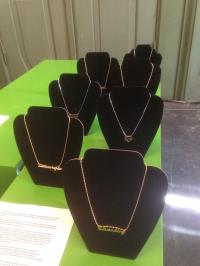
“Kaert barn har mange navne” is a Danish saying meaning the one you have dear has many names. Used mainly for sarcastic situations; here too it is meant in a sarcastic manner. Migrants and their descendants have many names in Denmark; names, nick names and very derogative names. The series of work “Kaert barn har mange navne” is a compilation of these. Collected in my memory since I was a child and mainly from the 1990’ies and up until today.

 The making of the golden necklaces have occurred out of a personal urge to question the stereotyping, that is often being made towards ordinary immigrants and their descendants in Denmark.

 Wearing these names on a necklace should normally check the typical boxes of the stereotyping of migrant names. These types of necklaces are the ones we recognise on the necks of young New Danes (nydanskere (new Danes) after each summer holiday in their mother countries. Mainly from Turkey and the Middle East. They are normally displaying the names of the one who bears the necklace; a form of identity creation for young ethnic minority youth, especially girls.

 When looked at from a distance these necklaces are expected to complete the idea of the stereotyped migrant. Usually spelling out unpronounceable names in ‘yellow golden’ letters. (being the bearer of the “Yellow golden” necklaces, is even a Turkish stereotyping of Turkish immigrants to Europe.)

 The words here are carefully chosen (read: plucked out) from the horrific media hetz towards migrants since the mid 1990s. These mostly negative nicknames are displayed in the golden necklaces.

Although the stereotype of the migrant is one who usually ‘cannot speak’ (Gayatri Spivak’s term ‘the subaltern’) and who is always labeled by different groups in society, here in this work the migrant itself finally gets a voice talking back to the stereotyping name-makers for immigrants in Denmark via these necklaces.

 As well as simultaneously being a surprise and shock to the Danish viewers on intend, who are part of constantly creating and re-creating negative discourses on migrant issues. The necklaces are deliberately made to keep the language, visual form of discrimination and discourse of the person who consciously and unconsciously stereotypes migrants and other marginal groups. The other.

 I want these necklaces to be a mirror of those everyday conflicts taking place in Denmark, not just in the newspapers, but also in public spaces and especially in public transportation, where I happen to write most of my ideas, reflections and anticipations on this pressuring issue on Denmark and its ethnic minority groups.

 Although this work is from 2013, the recent discussions and rhetoric on “Danishness” http://nyheder.tv2.dk/samfund/2016-09-23-martin-henriksen-man-er-ikke-noedvendigvis-dansk-fordi-man-er-foedt-i-danmark shows us that these issues are never being dealt with or developed on.


Posted in almanci, art, Career, Denmark and migration, Photos

“Eurocentric Gaze”

“Eurocentric Gaze”

“Eurocentric Gaze”

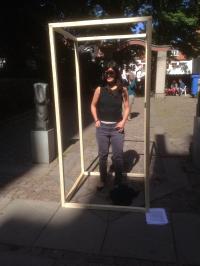
Performance in wooden box, as part of Muslimah Arts and Voices Exhibition at Kvindemuseet in Aarhus in Denmark.

Duration: 15 minutes.


The unspoken gaze, that I felt on my body for years, that was classified as “me being too aggressive” by Danish friends. Telling me I was seeing ghosts. (Although I was mainly known to be a good and quiet girl.)


‘…it wasn’t till I moved to London to study Arts and Cultural Studies that I found the root to all the unspoken and invisible in Danish society towards migrants.

Eurocentrism was taking a big part in the migrant psychology that I felt prone to in Denmark, but which strangely disappeared outside of Denmark.


Placing myself in the centre of uncomfortability and gazes.

Being partly a shy person, I have wanted to put myself in a situation of Danish “glosuppe” (soup of stares) for many years. As I want to be looked at/stared at from many angles (read: any angles) to make sure that it might end the eurocentric gaze of ‘othering me’, for being different due to historic traces of colonialism and now neo-colonialism.

Could Danes get full and contend, by being allowed to look at me and orientalize me for as much as 15 minutes at a time in performances standing in a box just being me, many times during today.


Reading on the theory of theorist Homi Bhaba an Edward Said I have indeed realized that the “eurocentric gaze” of Europeans and especially the very homogenic and mainly monocultural Danish culture is not intended. This gave me a certain relief and a huge urge to write and talk about “eurocentrism” in general when in Denmark.


The box calls for others who feel different to put themselves inside the box.

As “eurocentrism” is not per se the only problem in Danish society, simultaneously London life and culture taught me that the Danish Jante Law, that we see as long forgotten, unfortunately gives an ever-extending feeling of “small town mentality”, that regulates what we do and who we are via another gaze.


Posted in almanci, art, Career, Denmark and migration, Photos

Good NEWS!!Turkish girls are changing.

Looking at Turkish girls, of course I shouldn’t be generalizing, but I know what I see. For years being an ex-pat to Turkey, I have found that Turkish girls are/were in a specific way. The way they dress, behave, walk/move, stand on their legs, their attitudes, their gazes and even the color grade of their teints and grimasses, facial traek are different (read=recognizable, for me). (Maybe I stare too much..)


In trying to unveil what has made up this Turkisness in Turkish grls and women, we should take the problematized modernization process of Turkey into account. Which of course includes obstacles such as religion, male-dominated culture, social class et.c.


This time (May 2013) coming to Turkey made me realize that for the newer generation of girls/women these things are different. Their content at least in certain parts of bigger cities such as Istanbul, Ankara or Izmir have changed. How did this develop??

Something has  indeed changed, as I do not see the same indicators as I used to in these newer generations. This is surely undeniably due to globalization, neo-liberalism and its consumerism. As well as a change in the way women see themselves in the eyes of men. It seems that the internalized gaze in women making them shameful towards men are fading within these newer generations. Shame is no longer controlling them. As shamefulness is also not a part of the emotions that neo-liberalism is tetikliyor.

These girls look like they are almanci or just plain Europeans. They even dress better than the almancis or Europeans even. Trying to fill in the gap, that their mothers could not fill in. The desire to be like a European.


Posted in almanci, art, Career, Denmark and migration

Being Danish too:

Vagner sondag formiddag til en masse dejlig musik fra min kaereste. Pa trods af det skyndte jeg mig pa YouTube idet ojeblik han gik ud ad doren og fandt en masse danske sange frem. Nar ejg savner min familie og det at have en hverdag med et ordentligt meningsfuldt job, sa taenker jeg kun pa savnet af DK. Nostalgien for noget der var engang, men som  stadigvaek er der bare uden mig!

Trying to see myself and my identity from many different angles, I am in a constant search to hear what people think about me. Its mainly to do with my cultural identity of course. Is my Turkish as good as “homebased” Turks :), can they just out of looking at me, my clothes and my behaviour still see that I am a (proud) almanci?!

Interviewing myself (pretending a Dane is asking me): Does the Danes treat me the way I want/ expect and need them to when I especially meet them in London?=NO. Are they always shocked  and surprized to hear black hair speak Danish=YES!  (as this is all I come down to!!) its my iconography. Why is this still hurting me?=because a big part of my feels Danish as well and Im not just Turkish I know that!!

Well lets flip the coin! Am I surprized about this negative and very prejudiced behaviour towards me and my Danishness?!=Hell yeahhh!!and im even startled every single fucking time!! Does the Danes not know that I long for Denmark, speaking Danish, living in DK?! Dont they know that I am sad to be refused into the Danish society although I feel very Danish?! Dont they sense my teenagy rebellion towards them?as if DK were my parents that I was always trying to run away from? But some days like yesterday and today I sang and listened to Danish songs, cried and wanted to say sorry for all the times I got angry with good old Denmark! For years I was treating DK as a younger brother or sister telling him/her off for not being emotional or nostalgic about things. Then with one written comment on YouTube I realized that DK also is emotional and has ‘arabesqy’ songs that make people want to cry, remember and feel. I am also sorry for this not because i am prejudiced, coz i am from the Danish culture myself, but it is a fact that Danes dont show emotions the same way as Turkish people do. I have learned the emotional language of the Turkish culture they have learned theirs from the Danish culture. Their’s just seem more hidden and not as open. I often had problems with navigating through this. I always felt like I had to cut back on my emotions when being in a Danish context. I never liked it.

This is a comment from Youtube for this song: “Kim is the heart and soul of Danmark – he has survived and grown since the 70’s- look at the faces on the young audience – nobody, repeat nobody comes near to Kim’s talent for relating on an emotional level to Danes through music.

The audience is completely spellbound – me too -I lived in Denmark in the 80’s – can’t think of anybody in any other country who gets to the level Kim gets to. He’s unique and AWESOME!!! Love him and his music and his messages.”

Posted in almanci, art, Career, Denmark and migration

the post-it video (soon to be uploaded)

The Post-It video was an improvized/halfly planned video-performance (with a naive approach as the performer weighs her every little step.not totally aware of what she is doing yet or wat she wants to do. But she is obsessed with the veiled woman a certain orientalism catches the eye in the viewer..) where a whole year of research and tiny art works (drawings/stencil statemnets onto different surfaces and materials, consisting of ‘for’ and ‘against’ experiences from within the Muslim veil, from being the outside unveiled Muslim, living the migrant reality and psychology of a person with black hair =Perker, in Denmark.)But also simultaneously seeing things from a Danish European secular ateist racist perspective=totally assimilated and feeling ashamed of being an immigrant.
This was all giving voice to the tiny drawings of burka-wearing women with multiple choices of who to be rather than the stereotype that Western or especially the Danish media gives us. So the tiny size of the Post-It is in reality a memo, an easy way to make people act or do in a certain way. With a few words in tiny speech bubbles. As to much talk in an already busy metropol digitalized world wouldnt help much.
To change the situation with a few easy means (this could even catch on) trough a simple everyday object as a post-it memo that is such a big part of everyones lives/working lives.
This work is not just to give a voice to Muslim veiled women, but to women all of shades in Islam/Migrant spaces. This is also for me!!
Posted in almanci, art, Career, Denmark and migration, Photos
  • « Older Entries
  • 1
  • …
  • 7
  • 8
  • 9
  • 10
  • 11
  • …
  • 18
  • Newer Entries »

Categories

  • almanci
  • art
  • ayip-shame
  • Career
  • curation
  • Denmark and migration
  • Family
  • feminism
  • foodie
  • health stuff
  • Other stuff
  • Photos
  • Racisms in Denmark
  • Videos

Recent Comments

  • Hülya on Political ambience in Denmark
  • Katya Griffin on about me
  • ShoutStreatham on about me
  • Hülya on art works
  • wso download on Dont ever do homeopaths!

WordPress Theme Custom Community 2 developed by Macho Themes